
What Are the 27 Factors to Consider Before Buying a Bed?
The 27 factors to consider before buying a bed encompass a comprehensive evaluation of physical needs,
- Size
- Mattress Type
- Support & Comfort
- Material Quality
- Room Size & Layout
- Couples’ Comfort & Motion Isolation
- Sleeping Position
- Bed Height & Accessibility
- Storage Options
- Budget
- Durability & Warranty
- Trial Period & Return Policy
- Adjustability
- Breathability & Temperature Control
- Eco-Friendliness & Materials
- Allergy Considerations
- Aesthetics & Style
- Certifications & Safety
- Brand Reputation & Reviews
- Noise Level
- Ease of Assembly & Delivery
- Weight Capacity
- Headboard / Footboard Options
- Smart Features
- Pet- & Kid-Friendly Design
- Space Optimization
- Bed Frame Compatibility
We recognize the decision fatigue and financial stress frequently associated with mattress shopping. The sheer volume of choices often overwhelms consumers. This guide provides a comprehensive, 27-point framework to navigate complete sleep system selection, ensuring the next bed purchase aligns with specific physical needs, spatial limitations, and budget constraints. We approach this evaluation from the perspective of an objective sleep consultant, focusing strictly on functional requirements.
Why Evaluating Bed Buying Factors Matters Before You Shop for a Bed Purchase
Evaluating specific factors before buying a bed is mandatory; a new bed purchase represents a 7-to-10-year investment that directly dictates daily productivity and physical health. A 2021 study from the Journal of Sleep Research demonstrates that replacing a mattress older than 5 years reduces subjective back pain by over 40%. The physical implications of a poor choice directly impact spinal alignment and muscle recovery.
| Impact Area | Cost of Poor Sleep (Incorrect Bed) | Investment Return (Correct Bed) |
|---|---|---|
| Physical Health | Increased chronic back pain, poor spinal alignment, muscle stiffness. | Reduced pain markers (over 40% reduction per 2021 JSR study), optimal recovery. |
| Mental Acuity | Decreased focus, higher stress levels, impaired memory consolidation. | Enhanced daily productivity, stable mood regulation, improved cognitive function. |
| Financial Cost | Frequent replacements (every 2-4 years), potential medical bills for pain management. | Long-term durability (7-10 years), reduced healthcare expenditures related to sleep issues. |
The financial implications of poor purchasing workflows are equally significant. Buyers who fail to assess logistics often encounter unexpected delivery fees or realize their existing foundation voids the new warranty. A structured process prevents buyer’s remorse and secures the financial investment.
Flowchart: The Complete Bed Buying Workflow
- 1 Assess Needs: Determine sleep position, physical pain points, and couple requirements.
- 2 Select Materials: Choose mattress type (foam, innerspring, hybrid, latex) based on needed support and breathability.
- 3 Determine Sizing: Calculate room dimensions and required bed size (Queen, King, etc.).
- 4 Verify Foundation: Ensure existing or new frame compatibility and check warranty requirements.
- 5 Review Logistics: Confirm budget, sleep trial, return policy, and delivery methods.
- 6 Finalize Purchase: Execute the final 27-point pre-purchase inspection checklist.
Assess Your Physical and Health Needs Before Choosing a Bed Purchase (Factors 1-7)
The necessary support and comfort layers of a bed purchase are dictated entirely by specific physical and health needs, ranging from sleep position to chronic pain.
| Priority Level | Assessment Area | Key Decision Variable |
|---|---|---|
| High | Sleeping Position | Side (Softer), Back (Medium-Firm), Stomach (Firm) |
| High | Physical Pain/Support | Spinal alignment needs, pressure relief requirements |
| Medium | Couples’ Needs | Motion isolation capability, edge support strength |
| Medium | Weight Capacity | Comfort layer thickness, coil gauge/support core strength |
Factor 1: Determine optimal Size for your Bed Purchase
The physical Size of the mattress must accommodate the sleepers for a successful bed purchase; individuals taller than 6 feet should prioritize a California King, which provides an additional 4 inches of length compared to a standard King. A standard Queen measures 60 inches wide by 80 inches long. A standard King measures 76 inches wide by 80 inches long. These dimensions strictly dictate spatial planning.
Factor 2: Decide on a Mattress Type for your Bed Purchase
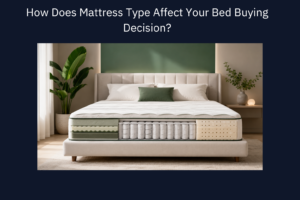
The Mattress Type dictates the physical feedback of the bed purchase; memory foam provides deep contouring, innersprings offer responsive bounce, and a hybrid mattress provides a balanced combination of both. Memory foam absorbs kinetic energy, whereas coil systems reflect it. For a complete breakdown of how this contouring compares to coil systems, review our definitive guide on Memory Foam vs. Innerspring mattresses.
Memory Foam
Deep contouring & motion absorption
Innerspring
Responsive bounce & kinetic reflection
Hybrid
Balanced combination of foam & springs
Factor 3: Determine optimal Support & Comfort for your Bed Purchase
Support & Comfort must align directly with an individual’s sleeping posture for a successful bed purchase; side sleepers require softer pressure relief, back sleepers need medium-firm support for spinal alignment, and stomach sleepers demand a firm surface to prevent hip sinkage. Medium-firm support maintains neutral spinal alignment for back sleepers. Proper alignment prevents muscular strain during the sleep cycle.
Optimal Comfort Layer by Position
Side Sleepers
Softer relief for shoulders & hips
Back Sleepers
Medium-firm for neutral spinal alignment
Stomach Sleepers
Firm support to prevent pelvis sinkage
Factor 4: Verify Material Quality for your Bed Purchase
Material Quality dictates the functional lifespan of the bed purchase; high-density foams and heavy-gauge steel coils resist sagging and wear significantly better than lower-grade components. High-quality edge support requires minimum 1.8 PCF (Pounds per Cubic Foot) density foam encasements. Premium memory foam should be at least 4.0 PCF to ensure longevity.
Factor 5: Evaluate Room Size & Layout for your Bed Purchase
Room Size & Layout strictly dictate maximum dimensions for a bed purchase; standard architectural principles require a minimum of 24 to 36 inches of clearance around the sides and foot of the bed for functional movement. This clearance prevents structural cramping and allows for unhindered room navigation.
Factor 6: Evaluate Couples’ Comfort & Motion Isolation for your Bed Purchase
Couples’ Comfort & Motion Isolation are critical for shared bed purchases; motion isolation defines the bed’s ability to absorb movement, preventing sleep disruption when one partner shifts. Memory foam absorbs kinetic transfer effectively. Continuous coil systems transfer motion across the surface.
Factor 7: Evaluate your Sleeping Position for your Bed Purchase
Sleeping Position dictates the necessary depth of the comfort layer in a bed purchase; side sleepers require deeper contouring to accommodate shoulders and hips, whereas back and stomach sleepers require shallower comfort layers to maintain a neutral spine. Shallow comfort layers prevent the pelvis from sinking out of alignment.
Choose the Best Mattress Type and Material Quality for Your Bed Purchase (Factors 8-12)
Choosing the correct material for a bed purchase requires matching previously identified physical needs with the specific performance characteristics of various material types to ensure high Material Quality.
Factor 8: Consider Bed Height & Accessibility for your Bed Purchase
Bed Height & Accessibility impact daily biomechanics and must be considered during a bed purchase; the total height of the sleep system (mattress + foundation + frame) should allow the user to sit on the edge with knees bent at a 90-degree angle and feet flat on the floor. The average ideal total bed height is 24 to 25 inches from the floor.
Factor 9: Evaluate Storage Options for your Bed Purchase
Storage Options enhance utility in a bed purchase; buyers needing to maximize cubic storage should select a hydraulic lift bed or a frame with integrated drawer bases. Hydraulic beds lift the entire mattress platform vertically. Drawer bases pull outward horizontally, requiring additional floor clearance.
Factor 10: Establish a realistic Budget for your Bed Purchase
A realistic Budget must encompass all associated costs in a bed purchase; this includes the mattress, local taxes, a compatible foundation, delivery logistics, and old mattress removal fees. High-quality Queen hybrids typically range from $1,200 to $2,000. Consumers must account for these secondary expenses to avoid budget overruns.
Factor 11: Review the Durability & Warranty for your Bed Purchase
Durability & Warranty terms legally protect the investment in a bed purchase; an industry-standard warranty covers manufacturing defects for a minimum of 10 years but mandates the use of a proper foundation. Warranties are voided by improper support or liquid stains. Standard warranties only cover visible sagging greater than 1 to 1.5 inches.
Factor 12: Understand the Trial Period & Return Policy for your Bed Purchase
The Trial Period & Return Policy mitigate online purchasing risks for a bed purchase; a standard sleep trial lasts 100 nights, but buyers must verify if return shipping or hidden restocking fees apply. Most companies require a mandatory 30-day “break-in” period before they legally authorize a return. This period allows materials to adjust to the sleeper’s body weight.
Select the Right Size, Dimensions, and Space Optimization for Your Bed Purchase (Factors 13-16)
Selecting precise dimensions for a bed purchase ensures the product accommodates the physical size of the sleepers while maintaining functional Space Optimization within the bedroom architecture.
Factor 13: Look into Adjustability for your Bed Purchase
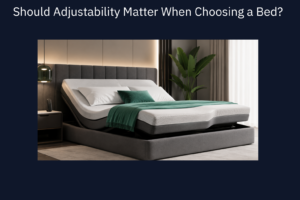
Adjustability caters to varying structural needs in a bed purchase; an Adjustable bed allows users to independently change the elevation of the head and feet to alleviate conditions like acid reflux or snoring. Elevation adjustment alleviates sleep apnea symptoms by keeping airways open.
Factor 14: Assess Breathability & Temperature Control for your Bed Purchase
Breathability & Temperature Control are essential for restorative rest in any bed purchase; hot sleepers must prioritize breathable materials or active phase-change cooling technologies over traditional, heat-retaining foams. Passive cooling relies on structural airflow, such as air moving through coil systems.
Active cooling utilizes phase change materials to absorb and dissipate body heat actively.
Factor 15: Prioritize Eco-Friendliness & Materials for your Bed Purchase
Prioritizing Eco-Friendliness & Materials ensures low chemical emissions in a bed purchase; natural latex and organic cotton covers eliminate off-gassing associated with synthetic polyurethanes. Dunlop processing yields a denser, heavier latex layer. Talalay processing results in a lighter, more consistent latex foam.
Factor 16: Consider Allergy Considerations for your Bed Purchase
Addressing Allergy Considerations dictates material choice in a bed purchase; individuals with sensitivities should seek naturally hypoallergenic materials, such as Latex mattresses, that actively resist dust mites and mold. Dust mites are responsible for the majority of bedroom-related respiratory allergies.
Choose a Bed Frame and Foundation That Completes Your Bed Purchase (Factors 17-21)
Choosing the correct structural support is imperative to complete your bed purchase; incompatible foundations can immediately void the mattress warranty and physically degrade the core materials.
Anatomy of Compatibility
Choosing the correct structural support is imperative to complete your bed purchase; incompatible foundations can immediately void the mattress warranty and physically degrade the core materials. The structure stacks to create your complete sleep system.
Factor 17: Consider Aesthetics & Style for your Bed Purchase
Aesthetics & Style influence the visual weight of the bedroom when making a bed purchase; the durability of solid wood and steel frames must be weighed against the softer visual appeal of upholstered options. Solid surfaces require simple dusting protocols.
Upholstered frames demand regular vacuuming to remove accumulated allergens.
Factor 18: Check for Certifications & Safety for your Bed Purchase
Certifications & Safety ratings ensure low chemical emissions for a bed purchase; buyers must demand independent certifications like CertiPUR-US for foams and Global Organic Textile Standard (GOTS) for organic textiles. CertiPUR-US foams are made without ozone depleters, PBDEs, TDCPP, or TCEP flame retardants.
Factor 19: Read verified Brand Reputation & Reviews for your Bed Purchase
Brand Reputation & Reviews reveal actual long-term performance for a bed purchase; to gauge true durability, buyers must seek out reviews specifically mentioning the bed’s condition after 6 to 12 months, rather than initial unboxing impressions. Consumers must filter promotional comments and scrutinize long-term durability reports.
Factor 20: Minimize Noise Level for your Bed Purchase
Noise Level directly disrupts sleep continuity and must be evaluated during a bed purchase; metal frames with loose joints or old box springs generate significant squeaking, which negatively impacts sleep architecture, especially for couples. Mortise and tenon construction joints minimize friction and structural noise effectively.
Factor 21: Pre-evaluate Ease of Assembly & Delivery for your Bed Purchase
Ease of Assembly & Delivery logistics must be planned prior to checkout for a bed purchase; White-glove delivery includes in-home setup and packaging removal, which is highly recommended for premium, high-weight mattresses. Compressed “bed-in-a-box” shipping utilizes vacuum sealing for easier immediate transport.
Traditional flat-freight delivery transports the mattress in its fully expanded state.
Navigate Budget, Warranties, and Purchasing Logistics for Your Bed Purchase (Factors 22-27)
Navigating the logistics of a bed purchase requires strictly evaluating the Warranty and Trial Period before committing funds.
Factor 22: Assess your Weight Capacity needs for your Bed Purchase
Evaluating Weight Capacity ensures structural integrity for your bed purchase; individuals over 230 lbs require thicker comfort layers and stronger support cores (such as lower-gauge steel coils) than individuals under 130 lbs to prevent premature sagging. Coil gauge indicates the thickness of the wire; a lower gauge number equates to thicker, stronger steel wire.
Factor 23: Decide on Headboard / Footboard Options for your Bed Purchase
Headboard / Footboard Options affect both design and physical function in a bed purchase; while headboards provide necessary back support for sitting, footboards restrict legroom for taller individuals and enclose the sleeping space. Footboards restrict usable bed length.
Factor 24: Evaluate Smart Features for your Bed Purchase
Smart Features offer advanced biometric functionality for a modern bed purchase; modern sleep systems incorporate sensors to track respiration and heart rate, appealing to data-focused consumers. Sensors track precise physiological metrics throughout the night.
Factor 25: Account for Pet- & Kid-Friendly Design in your Bed Purchase
Pet- & Kid-Friendly Design often requires expansive surface areas for a bed purchase; couples sharing a bed with children or large pets generally require a King size to maintain uninterrupted sleep cycles. A King size offers adequate spatial separation for multiple occupants.
Factor 26: Prioritize Space Optimization for your Bed Purchase
Space Optimization is crucial in constrained environments when making a bed purchase; utilizing the vertical space below a high-clearance bed frame can offset a smaller bedroom footprint. The homeowner manages spatial constraints by selecting integrated storage frames.
Factor 27: Ensure strict Bed Frame Compatibility for your Bed Purchase
Bed Frame Compatibility is non-negotiable for a bed purchase; modern foam and hybrid beds require solid surfaces or closely slatted foundations, whereas traditional innersprings utilize a standard box spring. Platform beds often provide the necessary solid support for foams. Slats for foam mattresses must be no more than 2.75 to 3 inches apart to prevent material extrusion.
Prevent Common Bed Buying Mistakes That Lead to Buyer’s Remorse After a Bed Purchase
Avoiding common pitfalls ensures long-term satisfaction with your bed purchase; testing a bed incorrectly in-store or ignoring foundation requirements often leads directly to buyer’s remorse and physical discomfort. The correct in-store testing method requires lying down for a minimum of 15 minutes in the primary sleep position. We acknowledge the awkwardness inherent in testing beds in a public showroom setting; however, this step remains an absolute necessity for validating support. Using an old, incompatible box spring with a new foam mattress constitutes the number one cause of premature sagging and immediately voids manufacturer warranties.
Final Bed Selection Checklist to Complete Your Bed Purchase
Before finalizing the transaction, use this comprehensive pre-purchase inspection checklist to guarantee every aspect of the new bed purchase meets established structural and physical requirements. A methodical approach guarantees a successful investment in sleep health.
Checklist – The 27-Point Pre-Purchase Bed Inspection
Physical Needs:
Materials & Build:
Space & Design:
Foundation:
Logistics & Business:
Citations & References
- Journal of Sleep Research (2021): Study demonstrating that replacing a mattress older than 5 years reduces subjective back pain by over 40% and improves spinal alignment and muscle recovery.
- CertiPUR-US® Guidelines: Safety standards verifying foams are made without ozone depleters, PBDEs, TDCPP, or TCEP flame retardants.
- Global Organic Textile Standard (GOTS): Independent certification standards for organic textiles and low chemical emissions.
- Ergonomic Architecture Standards: Principles dictating minimum 24 to 36 inches of bedroom clearance and ideal seated bed height biomechanics (24 to 25 inches from the floor).
- Guide: Memory Foam vs. Innerspring Mattresses: Comprehensive breakdown of kinetic energy absorption versus coil system reflection mentioned in Factor 2.
Note: The 27-point framework provided in this guide approaches evaluation strictly from the perspective of an objective sleep consultant, focusing on functional requirements, physical needs, and spatial limitations.

Mohamed Abdirahman Camay is the founder and lead content specialist at BedLuFix. He researches bed types, bed frames, mattress compatibility, sleep comfort, support systems, bedroom layouts, and key bed-buying factors. His research process includes reviewing manufacturer specifications, comparing product features and materials, and analyzing common consumer questions. He also develops practical bed calculators, comparison tools, checklists, and templates that simplify bed selection and bedroom planning. Mohamed creates clear guides and useful resources to help readers choose beds that suit their sleep needs, room size, lifestyle, and budget.