How Does Mattress Type Affect Your Bed Buying Decision?
Understanding the specific “mattress type” is the most critical step in your bed buying decision, as the core materials—whether memory foam, innerspring, hybrid, or latex—directly dictate your comfort, support, and overall sleep quality.
Many buyers prioritize bedroom aesthetics over foundational support. However, your mattress type dictates the physical sleep experience. This guide breaks down how different mattress compositions affect comfort, durability, and cost, helping you match the right material to your specific sleep needs before you make a purchase.
Consumers frequently encounter a confusing market filled with competing claims. Evaluating the mattress type establishes an objective baseline for comparison. Your unique body weight and sleeping habits require specific material responses. Identifying the correct mattress type prevents wasted money and ensures long-term physical support.
Why Mattress Type Matters Before You Buy a Bed
The “mattress type” matters profoundly before you buy a bed because the internal composition dictates the entire sleep experience, from pressure relief to temperature regulation, regardless of the bed frame’s design.
Defining “mattress type” means categorizing the foundational core material inside the bed. The mattress type shapes the sleep experience first, making the external bed foundation a secondary compatibility check. Buyers often fear insufficient support. According to the Sleep Foundation, internal material directly impacts your sleep quality. Mattress type is one of the main factors to consider before buying a bed because it controls comfort, support, cooling, and long-term durability.
Comparing core materials reveals specific benefits for different sleepers:
- Comfort and Feel: Materials determine physical sensation, separating deep contouring from responsive bounce.
- Durability and Lifespan: Construction quality dictates how long materials resist sagging.
- Cost and Value: Material complexity establishes the baseline budget versus premium pricing.
- Temperature Regulation: Internal structures control heat retention versus active breathability.
Now that we understand why mattress type matters, let’s define the primary materials available on the market.
What Are the Main Mattress Types Available?
The mattress market is primarily categorized into four main “mattress types”: Memory Foam, Innerspring, Hybrid, and Latex, each defined by distinct internal materials and construction methods.
Understanding “mattress composition”—the internal arrangement of layers—clarifies how each bed performs. A mattress is like a layered support system, where the comfort layer cushions the body and the support core stabilizes the spine. Proper material construction directly influences daily performance.
Interactive Material Layer Composition
Explore the core construction layers that define the four primary mattress types.
1. Memory Foam
Dense comfort layers contour deeply to absorb weight.
2. Innerspring
Interlinked metal springs deliver responsive pushback.
3. Hybrid
Blends pocketed coil systems with contouring foam.
4. Latex
Naturally responsive, breathable vertical air channels.
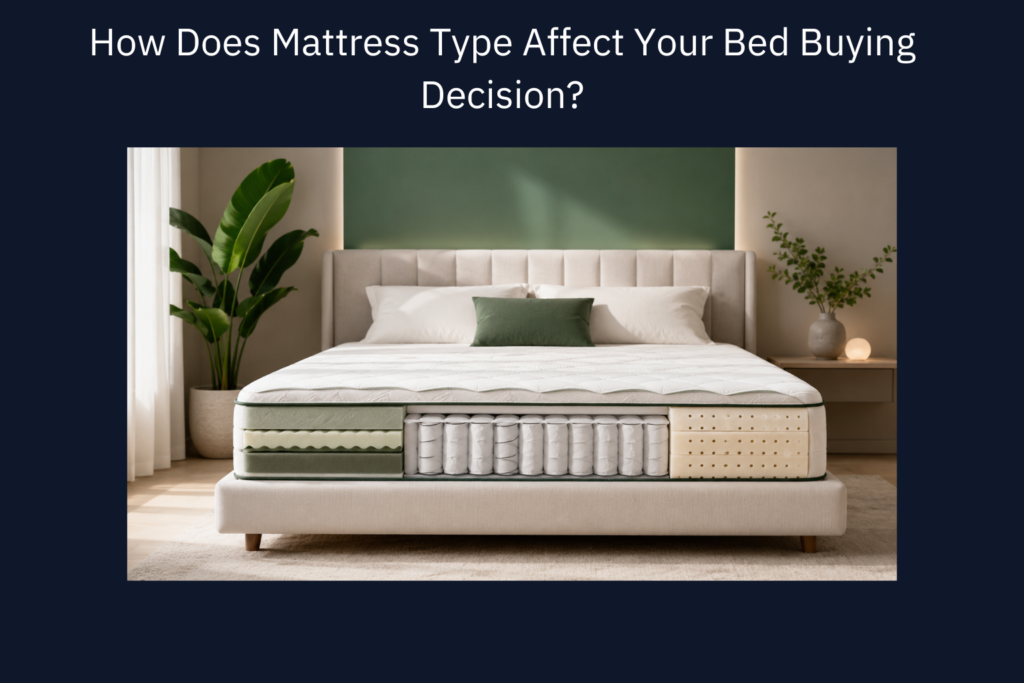
🔍 Diagram Breakdown: Understanding Mattress Layers
This cross-section displays the structural layers that dictate how a mattress behaves under load. The top comfort layers absorb immediate weight and cushion joints, while the bottom support cores stabilize the spine. Pay close attention to how memory foam distributes sinkage through pure polyurethane foam, innersprings maximize airflow with open metal coils, hybrids combine pocketed coils with protective upper foams, and natural latex uses aerated channels to balance bounce with passive cooling.
Memory Foam
Memory foam utilizes polyurethane foam that contours closely to the body. This material absorbs kinetic energy effectively. Side sleepers often choose memory foam to prevent joint pain. The high-density structure provides significant pressure relief.
Innerspring
Innerspring mattresses feature a traditional support system built primarily of metal coils. The Better Sleep Council notes that coil gauge affects firmness. Stomach sleepers benefit from this rigid surface. Coil systems generate high airflow.
Hybrid
Hybrid models combine a coil support system with thick comfort layers of foam or latex. This construction blends robust support with surface contouring. Couples often select hybrids for balanced performance. The pocketed coils isolate movement effectively.
Latex
Latex derives from rubber tree sap or synthetic alternatives, known for responsiveness and durability. Talalay latex provides a softer feel, while Dunlop latex delivers firmer support. Eco-conscious buyers frequently prefer natural latex. The material naturally resists dust mites.
With the main categories defined, we must evaluate how they perform against core buying criteria.
How to Compare Mattress Types by Comfort, Support, Cooling, Durability, and Budget
To make an informed bed buying decision, you must compare the four main “mattress types” across core metrics: comfort feel, support, cooling capabilities, durability, and typical budget.
Evaluating these options requires understanding “temperature regulation,” which dictates how a material retains or disperses heat. Material construction directly influences cooling efficiency. The Sleep Foundation’s cooling ratings highlight the disparity between dense foam and aerated coils. Hot sleepers should compare breathability and temperature control before choosing foam, innerspring, hybrid, or latex.
The Cooling vs. Contouring Matrix
Hover over or tap the mattress categories to see how they align along the heat retention and contour support spectrums.
Memory Foam
Excellent pressure relief and body contouring, but poor cooling due to heat retention.
Hybrid
Balanced deep-contouring & support core airflow. Good compromise for couples.
Latex
Aerated foam enables strong cooling combined with active, springy pushback support.
Innerspring
Excellent airflow core with responsive surface bounce, but lacks localized pressure relief.
📊 Map Interpretation: Airflow vs. Contouring Dynamics
This matrix maps each material category across the two most crucial vectors of sleep comfort: Contouring (vertical axis) and Airflow / Cooling (horizontal axis). Interacting with the nodes reveals how Memory Foam sits in the upper-left (maximum contouring but highest heat retention), while traditional Innerspring sits at the bottom-right (maximum passive cooling with high bounce). Hybrids and Latex occupy the balanced middle-ground, helping hot sleepers or restless partners identify their optimal structural compromise.
Review the comparison matrix below to evaluate your options efficiently.
| Mattress Type | Comfort Feel | Support | Cooling | Durability | Best For | Weak Point | Typical Budget |
|---|---|---|---|---|---|---|---|
| Memory Foam | Deep contouring | Good, pressure-relieving | Poor to Fair (traps heat) | Fair to Good | Side sleepers | Heat retention | Budget to Mid-range |
| Innerspring | Bouncy, firm | Very Good | Excellent | Fair | Back/stomach sleepers | Poor motion isolation | Budget to Mid-range |
| Hybrid | Balanced contouring | Excellent | Good to Very Good | Good to Very Good | Combo sleepers | Heavy, can be expensive | Mid-range to Premium |
| Latex | Bouncy, responsive | Excellent | Very Good | Excellent | Eco-conscious | Heavy, limited deep sinkage | Premium |
*(Source Note: Cooling and airflow claims align with Sleep Foundation material guidance; Budget ranges reflect current mattress retail pricing research).*
Beyond general performance metrics, your personal sleep position is the ultimate decider.
How to Compare Mattress Types by Sleep Position
Your primary sleep position is the most critical factor in choosing a “mattress type,” as different positions require specific levels of contouring and spinal support.
The “support core” serves as the foundational layer dictating alignment. Sleep position determines your exact support requirement. Side sleeping concentrates pressure on the hips and shoulders. Back sleeping requires lumbar stabilization. According to Harvard Health sleep ergonomics guidelines, proper spinal alignment dictates your mattress choice.
Find Your Mattress Fit by Sleep Position
Select your primary sleeping posture below to visualize the ergonomic path and matches.
Recommended: Memory Foam & Soft Hybrids
Deep, cradling comfort layers yield under load, preventing pressure hotspots on your hips and shoulders.
💡 Interactive Guidance: Sleep Ergonomics Path
Your sleep posture fundamentally dictates where pressure builds and how your spine aligns. Use this interactive pathing tool to match your sleeping posture with its optimal support core. Side sleepers require thick, deep-conforming comfort layers to allow the shoulders and hips to compress without putting stress on the lower back. Back and stomach sleepers require rigid support to prevent the pelvis from sagging. Active combo sleepers require elastic responsiveness to shift positions easily throughout the night.
| Sleep Position | Recommended Mattress Type | Reason |
|---|---|---|
| Side Sleepers | Memory Foam, Soft Hybrids | Deep contouring absorbs pressure on hips and shoulders. |
| Back/Stomach Sleepers | Innerspring, Firm Latex, Firm Hybrids | Robust support stabilizes the hips, supporting spinal alignment. |
| Combo Sleepers | Latex, Hybrids | Responsive surfaces distribute weight during movement without feeling “stuck.” |
*(Source Note: Spinal alignment and support mechanics based on Harvard Health sleep ergonomics).*
In addition to sleep position, specific health or comfort needs require targeted materials.
How to Choose the Right Mattress Type for Specific Sleep Needs
Beyond sleep position, selecting the right “mattress type” involves addressing specific sleep needs, such as managing back discomfort, temperature regulation, or allergen reduction.
Proper “pressure relief” requires the dispersion of body weight to prevent localized pain. Mattress type determines how effectively a bed delivers pressure relief. Buyers experiencing joint stiffness need specific material responses. Mattress type should also match support and comfort needs because different materials handle pressure relief and spinal alignment differently.
- If Back Pain: Choose a medium-firm Memory Foam or Hybrid mattress. Result: May support spinal alignment by balancing contouring and support.
- If Hot Sleeper: Choose an Innerspring or cooling Latex mattress. Result: Maximizes airflow and provides inherent temperature regulation.
- If Allergies: Choose a natural Latex mattress. Result: May reduce allergen exposure due to naturally hypoallergenic material properties.
*(Source Note: Allergy reduction claims based on Sleep Foundation latex guidelines).*
Once you have matched your comfort needs, you must assess the long-term viability of the material to avoid wasting money.
How to Evaluate Durability and Lifespan by Mattress Type
The durability and lifespan of your bed are directly tied to your chosen “mattress type,” impacting the long-term return on your investment.
Strong “edge support” involves perimeter reinforcement that prevents roll-off and sagging. Material quality actively extends mattress lifespan. Latex generally resists sagging the longest. Innerspring models typically exhibit the shortest lifespan. Foam and hybrids fall in the middle regarding longevity.
The Better Sleep Council’s mattress replacement guide provides standard lifespan averages:
- Latex: 10–15+ years
- Hybrid: 7–10 years
- Memory Foam: 7–10 years
- Innerspring: 5–8 years
Understanding lifespan helps manage expectations, but avoiding common shopping traps secures your investment.
Avoid Common Mistakes When Selecting a Mattress Type
Avoiding common mistakes when selecting a “mattress type” is crucial for ensuring long-term satisfaction and preventing costly returns.
Evaluating “motion isolation” helps couples gauge the ability to absorb movement, preventing it from transferring across the bed. Buying mistakes increase your return risk. Standard Sealy and Tempur-Pedic manufacturer warranty conditions dictate strict foundation requirements.
- Rule: Don’t buy based solely on a friend’s recommendation.
- Reason: Comfort is subjective and highly dependent on individual body type and sleep position.
- Mistake: Ignoring mattress foundation compatibility.
- Why it matters: Certain “mattress types,” particularly memory foam and some hybrids, require a solid or closely slatted base to prevent sagging and voiding the warranty.
Good vs. Bad Examples:
- Bad: Buying memory foam just because it is currently popular.
- Good: Choosing memory foam because you are a side sleeper who requires targeted pressure relief.
- Bad: Buying an innerspring mattress only because it is the cheapest option.
- Good: Choosing an innerspring mattress because you specifically require high airflow, bounce, and firm support.
To avoid these pitfalls, use a systematic checklist before completing your purchase.
How to Finalize Your Mattress Type Decision Before Buying a Bed
To finalize your “mattress type” decision before buying a bed, complete this final checklist to ensure your choice aligns with your needs and your planned bed foundation.
Verifying “foundation compatibility” secures the mechanical match between a mattress core and the bed frame beneath it. Completing a final checklist reduces purchase errors. The Better Sleep Council’s buying tips validate a structured evaluation approach. After choosing the right mattress type, compare bed frame compatibility because each mattress construction needs the correct support base.
For a rapid review of these factors, consult the attribute table below.
Mattress Type Attribute Table
The following table summarizes the core attributes of the main “mattress types” to finalize your comparison.
The “comfort layer” represents the top section of a mattress designed for initial pressure relief. Material construction directly dictates these performance attributes. Identifying these traits streamlines the final selection process.
| Attribute | Value or Explanation |
|---|---|
| Main mattress types | Memory foam, innerspring, hybrid, latex. |
| Best pressure relief | Memory foam and soft hybrids. |
| Best airflow | Innerspring and latex. |
| Best balance | Hybrid. |
| Best durability | Latex. |
| Best motion isolation | Memory foam and hybrid. |
| Best bounce | Innerspring and latex. |
| Foundation check | Foam and hybrid mattresses often need solid or closely spaced slats. |
This comprehensive overview leads directly to our final recommendations.
Conclusion
Mattress type should be finalized before brand, price, or bed frame style because mattress construction controls comfort, support, cooling, durability, and foundation compatibility.
Reviewing a “sleep trial” guarantees a period allowing in-home testing of the mattress type. Choosing the correct mattress type establishes your purchasing foundation. Material structures heavily dictate pressure relief, motion isolation, and airflow. At Bedlufix, we recommend choosing mattress type based on sleep position, comfort needs, and support requirements before comparing brands or styles.
Armed with this knowledge, you can confidently select the mattress core that will provide years of restful sleep.
If you still have lingering questions, review these quick answers.
Quick Answers About Mattress Type Before Buying
To clarify the final details, these quick answers address the most common questions buyers have about selecting a “mattress type.”
Understanding your “mattress warranty” clarifies the manufacturer’s guarantee against specific structural defects. Matching your mattress type actively solves specific user queries.
What are the main types of mattresses?
The four main types are memory foam, innerspring, hybrid, and latex. Each category utilizes distinct core materials. These materials dictate structural support and surface comfort differently.
Which mattress type is best for side sleepers?
Memory foam and soft hybrid mattresses best support side sleepers. The soft comfort layers compress efficiently. This compression absorbs pressure at the hips and shoulders. *(Source: Harvard Health Sleep Ergonomics)*
Which mattress type is best for hot sleepers?
Innerspring and natural latex mattresses regulate temperature best. Rigid coil structures and aerated latex foams inherently maximize airflow. These breathable materials actively prevent overnight heat retention. *(Source: Sleep Foundation Cooling Guide)*
Which mattress type lasts the longest?
Natural latex mattresses generally outlast other types. High-quality latex often resists sagging for 10 to 15 years. High-density hybrid models closely follow latex in overall longevity. *(Source: Better Sleep Council Replacement Guide)*
Is a hybrid mattress better than memory foam?
Neither mattress type performs universally better. Hybrids distribute body weight smoothly with responsive bounce. Memory foam isolates motion effectively and provides deeper, localized contouring.
Which mattress type is best for couples?
Hybrid and memory foam mattresses serve couples exceptionally well. These dense constructions isolate motion transfer effectively. This structural absorption prevents one partner from disturbing the other.

Mohamed Abdirahman Camay is the founder and lead content specialist at BedLuFix. He researches bed types, bed frames, mattress compatibility, sleep comfort, support systems, bedroom layouts, and key bed-buying factors. His research process includes reviewing manufacturer specifications, comparing product features and materials, and analyzing common consumer questions. He also develops practical bed calculators, comparison tools, checklists, and templates that simplify bed selection and bedroom planning. Mohamed creates clear guides and useful resources to help readers choose beds that suit their sleep needs, room size, lifestyle, and budget.