
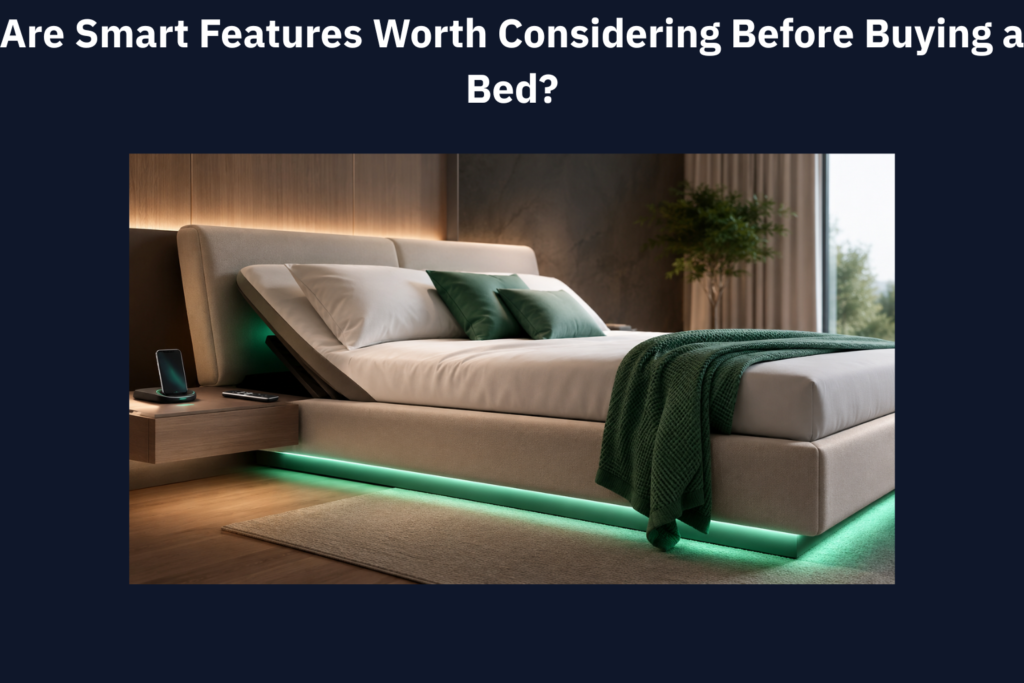
Are Smart Features Worth Considering Before Buying a Bed?
Deciding whether smart bed features are worth the premium depends on your sleep needs, budget, privacy tolerance, and desire for data‑driven adjustments — not on hype.
What Are Smart Features in a Bed?
Smart features in a bed include any electronically controlled element designed to monitor, adjust, or improve sleep, such as sensors, actuators, and connectivity modules. These features go beyond a simple mattress and base combination — they add a layer of intelligence that can respond to your body and environment in real time.
Defining the Smart Bed Ecosystem
The smart bed ecosystem comprises three core subsystems — sensing (e.g., ballistocardiography), actuation (e.g., adjustable air chambers), and user interface (e.g., app). These layers work together to create a feedback loop that can personalize your sleep environment.
Sensors can detect movement, temperature, heart rate, breathing patterns, and small body movements. Actuators respond by adjusting firmness, position, or temperature. The user interface ties it all together, giving you insight and control. The semantic triple is simple: Sensing layer → data processing → adjustment command → changed sleeping environment.
It is important to distinguish a smart bed (electronics built into the mattress or base) from an adjustable base plus a separately added tracker. The former is a unified system; the latter is a DIY approach with potential integration gaps. For more on the underlying technology, explore how sensor technology in mattresses works.
Common Smart Features Available Today
Today’s smart beds offer a range of features across three domains:
- Environmental control: Active temperature regulation, humidity sensing, and smart ventilation that respond to your body’s heat output.
- Sleep tracking: Ballistocardiography-based sensors that can estimate heart rate, breathing, movement, and sleep stages without requiring a wearable device. These estimates are not a replacement for clinical polysomnography.
- Ergonomic adjustment: Adjustable firmness zones, head-and-foot positioning, anti-snore tilt, and automatic position or firmness changes based on sensed sleep position.
Some models also include smart home integration, voice control, and sunrise‑simulating lighting. However, not every feature adds meaningful value — which brings us to the next distinction.
What Smart Features Are NOT — Separating Useful from Marketing
For this guide, a feature is considered meaningfully smart when it autonomously adjusts based on real-time data or provides actionable insights that can improve the sleep environment. A phone-controlled vibration massage pad may be connected, but it functions mainly as a remote-controlled feature. The practical test is whether the feature changes the sleep environment or provides useful information in a measurable way.
Use this practical test: Does it change the sleep environment? Does it provide information you can act on? If the answer is no, the feature may offer limited practical value. Automatic temperature adjustment that responds to changing conditions can be useful, while colour LED strips under the frame are mainly decorative.
How Do Smart Features Affect Sleep Quality?
Smart features affect sleep quality through three direct pathways — thermal regulation, positional comfort, and data‑driven habit feedback. Each pathway has a mechanism, evidence, and important caveats.
How Temperature Regulation Improves Sleep Continuity
Active temperature control can reduce thermal discomfort by cooling or warming the sleep surface. The body’s core temperature naturally changes around sleep onset, while a smart bed primarily adjusts the local sleep-surface temperature rather than the body’s circadian mechanism itself.
Research shows that thermal conditions can affect sleep quality and continuity. The review by Okamoto-Mizuno and Mizuno (2012) describes links between thermal environment, thermoregulation, and sleep [SB1]. Smart beds with active temperature control may help maintain a more comfortable microclimate, but the benefit depends on the product, settings, room conditions, and individual sleeper.
How Sleep Tracking Provides Insight — and When It Causes Anxiety
Sleep tracking can reveal useful patterns, but consumer devices estimate sleep stages and may differ from clinical polysomnography. For some users, constant feedback can contribute to orthosomnia, a term introduced by Baron and colleagues (2017) for excessive concern about improving or perfecting sleep-tracker data [SB2].
The positive side is that tracking can reveal patterns such as the impact of caffeine, stress, or late-night screen use. For sleepers who can engage with approximate data without obsession, it may provide a useful feedback loop. The negative side is that real-time scores can become a source of stress, especially for people already prone to sleep-related anxiety. Consumer tracker results are best treated as trends rather than diagnoses [SB3].
What Are the Trade‑Offs of Choosing a Smart Bed?
The primary trade‑offs of a smart bed are higher cost, potential electronic failure, privacy risks, and a learning curve — balanced against personalized sleep optimization. Understanding these trade‑offs is essential before making a purchase.
Higher Upfront Cost vs. Potential Long‑Term Sleep Gains
Smart beds usually cost more than comparable non-smart beds, but the added cost varies widely by brand, size, temperature system, adjustable base, subscription requirements, and included electronics. Use the higher cost as a comparison factor rather than assuming one universal premium. For people with persistent comfort problems, the potential value depends on whether a specific feature addresses the problem; smart features do not diagnose or treat an underlying medical condition.
Privacy Concerns: Where Does Your Sleep Data Go?
Smart beds may collect sensitive biometric and behavioural data such as heart rate, breathing patterns, movement, and estimated sleep stages. Depending on the product, data may be processed locally, in an app, or on cloud servers. Do not assume encryption, anonymization, retention, or third-party sharing practices are the same across brands. Check what data is collected, why it is collected, how long it is stored, who receives it, and whether you can access or delete it.
Reliability and Repairability of Electronic Components
Electronics add potential failure points because smart beds can include sensors, motors, circuit boards, pumps, and connectivity modules. Warranty coverage for electronics often differs from coverage for the mattress or base, so compare full coverage, prorated coverage, labour, parts, and exclusions. Look for modular designs where individual components can be replaced without replacing the whole system.
Compatibility with Existing Bed Frames and Mattresses
Not all smart beds work with every frame. Adjustable-base compatibility depends on the exact mattress construction and manufacturer approval, not only whether the mattress is labelled foam, hybrid, or innerspring. Platform slats may affect support, ventilation, or sensor placement in some systems, so check the required surface, slat spacing, clearance, weight limits, and base specifications. For guidance on compatible foundations, read our guide on durable adjustable bases.
Who Should Prioritize Smart Features — and Who Should Skip Them?
Smart features may be most useful for sleepers with persistent comfort needs, people who sleep hot, and couples with conflicting preferences; they may be unnecessary for consumers who already sleep well on a traditional bed and value simplicity. These features can support comfort and monitoring but should not be treated as medical diagnosis or treatment.
Ideal Candidates for Smart Features
- Persistent comfort needs: People with pressure points or frequent nighttime discomfort who may benefit from precise adjustability.
- Hot sleepers: Those who experience night sweats or overheating and can benefit from active temperature control.
- Couples with conflicting preferences: Partners who need different firmness levels, temperature zones, or sleep schedules.
- Data‑curious optimizers: Individuals who enjoy tracking metrics and making incremental adjustments to improve sleep.
- Tech‑first adopters: Users who are already comfortable with smart home ecosystems and value integration.
Who Should Skip Smart Features
- Simple sleepers: People who sleep well on a traditional mattress and do not want complexity or apps.
- Privacy‑sensitive users: Those uncomfortable with biometric data collection and cloud storage.
- Budget-focused buyers: Shoppers for whom the added cost would strain their budget without a clear need.
- Long-term minimalists: Users who prefer products with fewer electronic components and simpler maintenance.
- Platform bed owners: Those with existing frames that may not be compatible with adjustable bases or sensor arrays.
Edge Cases Worth Considering
Some sleepers fall in between. For example, someone who sleeps hot but is privacy‑sensitive might opt for a non‑smart cooling mattress rather than a fully connected system. A couple with different schedules might benefit from a dual‑comfort mattress without the app integration. The key is to match the feature to the problem, not to buy technology for its own sake.
How to Evaluate Smart Features When Shopping for a Bed
When evaluating a smart bed, focus on five criteria: warranty coverage for electronics, data privacy policy, trial period length, ease of manual override, and integration with your existing sleep environment.
Your Smart Bed Shopping Checklist
Questions to Ask the Retailer
- What happens to my sleep data if I return the bed? Can I request deletion?
- Are the electronic components replaceable individually, or is the entire base a single unit?
- What is the average response time for warranty claims on electronics?
- Does the bed function as a traditional mattress if the electronics fail?
- Is the temperature control system covered under the same warranty as the mattress?
In‑Store Testing Tips
If possible, test the bed in person. Lie in your typical sleep position for at least 10 minutes. Adjust the firmness and temperature settings yourself. Test the app interface — is it intuitive or cluttered? Ask whether the store model is running the latest firmware. And always check the noise level of motors and pumps during adjustment.
Final Verdict: Are Smart Features Worth It?
Smart bed features are worth considering if they address a specific comfort or sleep-environment problem, but they should never be the sole driver of your bed-buying decision. The choice comes down to your needs, budget, compatibility, tolerance for complexity, and comfort with data collection.
When Smart Features Make Sense
- You have a specific, persistent comfort issue, such as overheating or pressure discomfort, that a traditional mattress has not resolved.
- You are already comfortable with technology and willing to invest time in learning and optimizing a smart system.
- You value data and can engage with sleep metrics without becoming anxious about scores.
- Your budget allows for the added cost without compromising other sleep priorities.
When to Stick with a Traditional Bed
- You sleep well already and do not have unresolved comfort issues.
- You are uncomfortable with data collection or prefer not to have your sleep tracked.
- You want a simple, low-maintenance product with fewer electronic components that may require repair.
- Your budget is better spent on a high‑quality traditional mattress and pillows.
Final Recommendation
Start with the problem, not the technology. If you have a comfort or sleep-environment issue that a traditional mattress has not resolved, smart features may be worth considering. If you are mainly curious about new technology, consider finding a mattress that fits your budget first and adding compatible smart elements later. A smart bed is a tool, not a guaranteed solution, and the best bed is the one that supports comfortable, consistent sleep.
References
- [SB1] Okamoto‑Mizuno, K., & Mizuno, K. (2012). Effects of thermal environment on sleep and circadian rhythm. Journal of Physiological Anthropology, 31, 14. https://doi.org/10.1186/1880-6805-31-14
- [SB2] Baron, K. G., Abbott, S., Jao, N., Manalo, N., & Mullen, R. (2017). Orthosomnia: Are Some Patients Taking the Quantified Self Too Far? Journal of Clinical Sleep Medicine, 13(2), 351–354. https://doi.org/10.5664/jcsm.6472
- [SB3] Lee, X. K., Chee, N. I. Y. N., Ong, J. L., Teo, T. B. Y., van Rijn, E., Lo, J. C., & Chee, M. W. L. (2025). Performance of consumer wrist-worn sleep tracking devices compared to polysomnography: a meta-analysis. Sleep, 48(4), zsae260. https://doi.org/10.5664/jcsm.11460

Mohamed Abdirahman Camay is the founder and lead content specialist at BedLuFix. He researches bed types, bed frames, mattress compatibility, sleep comfort, support systems, bedroom layouts, and key bed-buying factors. His research process includes reviewing manufacturer specifications, comparing product features and materials, and analyzing common consumer questions. He also develops practical bed calculators, comparison tools, checklists, and templates that simplify bed selection and bedroom planning. Mohamed creates clear guides and useful resources to help readers choose beds that suit their sleep needs, room size, lifestyle, and budget.