Why Do Allergy Considerations Matter When Choosing a Bed?
Allergy considerations can matter when choosing a bed because mattresses, bedding, and nearby bed components can collect allergens. For sensitized sleepers, cleanability, encasement compatibility, moisture management, and material construction can influence exposure.
The goal is not to find a bed that promises to treat allergies. The practical goal is to choose a bed that is easier to protect, clean, maintain, and evaluate for your specific needs while still meeting your requirements for support, comfort, durability, temperature, and budget.
What Happens Inside a Bed That Triggers Allergies?
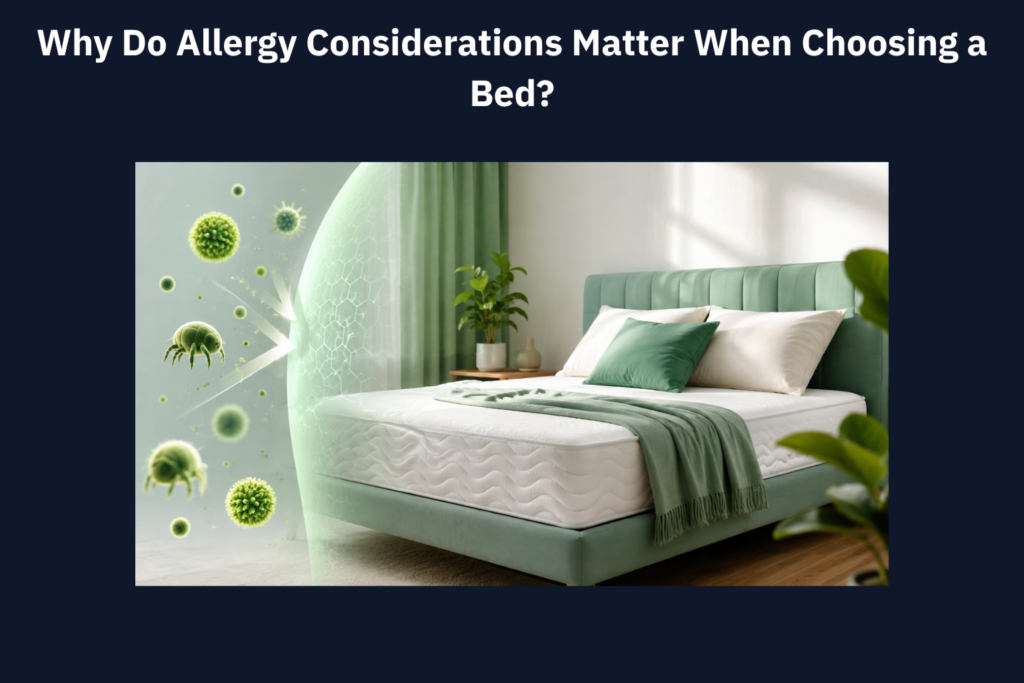
A bed can collect allergenic material over time because mattresses, bedding, covers, and nearby fabric surfaces regularly receive skin particles, dust, moisture, and other material from the sleep environment.
How dust mites, mold, and pet dander accumulate in mattresses and bedding
Dust-mite allergens, mold-related material, and pet dander can reach bedding through different pathways, so they should not be treated as one type of contamination.
Dust mites are living organisms, while household dust is a mixture of particles that can include allergenic material. Pet dander is deposited from animals or transferred particles. Mold-related concerns depend on moisture conditions rather than simply on the presence of a mattress.
Allergenic material can collect in covers, seams, quilting, pillows, bedding, and other fabric surfaces. A bed can therefore look clean while still containing particles that matter to a sensitized sleeper. The amount of accumulation varies with the environment, use, cleaning practices, covers, animals, moisture, and other conditions.
Why the bed's microclimate, warmth and moisture, can influence allergen conditions
Temperature, moisture, ventilation, bedding, and room conditions can influence the microenvironment around a mattress, but they do not affect every allergen in the same way.
Moisture conditions are especially relevant when considering dust mites and mold. The mattress also interacts with the wider sleep environment, including bedding layers, protectors, room humidity, ventilation, and the mattress construction itself.
Greater airflow does not automatically make a bed allergy-proof, and poor airflow alone does not prove that mold will develop. The useful buying question is whether the bed design makes moisture management, protection, and cleaning easier in your actual bedroom.
How allergen exposure from a bed can affect sensitized sleepers
For people who are sensitized to a specific allergen, repeated exposure around the sleep environment may contribute to symptoms, but the bed itself should not be presented as a diagnosis.
Because bedding stays close to the face and body for long periods, it can be one exposure area among many. That does not mean replacing a mattress will resolve symptoms, and persistent symptoms should not automatically be blamed on the bed.
This is why allergy-aware bed selection should focus on practical exposure-control features rather than medical promises.
Which Bed Materials Can Help Limit Allergen Accumulation?
Mattress material alone does not determine allergy suitability, so compare constructions by cleanability, moisture behavior, cover design, particle-retention surfaces, and compatibility with allergen barriers.
| Material / Construction | Potentially Useful Feature | What Can Complicate Allergy Control | What the Buyer Should Verify |
|---|---|---|---|
| Innerspring | Open internal structure may support ventilation | Padding, quilting, seams, and fabric surfaces can still collect particles | Cover design, cleaning access, protector compatibility |
| Memory Foam | Continuous foam construction may have fewer open internal cavities than a coil core | The foam core itself is usually not routinely washable | Removable cover, protector use, ventilation features, care instructions |
| Latex | Some latex layers use perforation or ventilation channels | Latex construction and cover design vary | Cover removability, layer construction, material composition, care requirements |
| Cotton / Wool Covers | Fiber-based covers may offer moisture-management or comfort properties depending on construction | Fiber name alone does not establish allergen resistance | Washability, backing, quilting, care instructions, barrier compatibility |
| Hybrid | Combines coil and comfort-layer characteristics | Allergy-related performance depends on the complete layer system | Top-layer construction, cover removability, encasement compatibility |
Innerspring vs memory foam vs latex: how construction changes allergy-related considerations
Innerspring, memory foam, and latex mattresses differ in internal structure, but those differences are most useful when translated into practical questions about cleanability, ventilation, cover design, and particle accumulation.
Open coil spaces, continuous foam layers, perforated latex, upper comfort layers, quilting, and covers can all change how easy a mattress is to protect and maintain. No material category should be treated as automatically best or worst for allergies.
Evaluate the complete mattress, especially the surfaces closest to the sleeper and any removable or washable components.
Cotton, wool, and synthetic covers: washability, moisture handling, and barrier compatibility
Cover material matters most when you evaluate how the surface handles moisture, whether it can be cleaned as directed, and whether it works with an effective allergen barrier.
Fiber type alone is not enough. Fabric construction, backing, quilting, removable-cover design, and care instructions can be just as important as whether the cover uses cotton, wool, or a synthetic material.
Natural, organic, or synthetic labels should not be treated as proof that a cover is allergy-safe.
Why "hypoallergenic" labeling is not enough to judge a bed
A "hypoallergenic" label should be treated as a claim to investigate rather than proof that a mattress will reduce a specific person's allergy symptoms.
Look for concrete product details instead, such as material composition, removable covers, care instructions, allergen-barrier compatibility, and evidence behind any specific performance claim.
If a seller makes a regulatory or medical-sounding claim, check what that claim actually means in the market where the product is sold rather than relying on the label alone.
How Does the Bed Frame and Foundation Affect Air Quality?
The frame and foundation can affect ventilation around the mattress, the number of dust-collecting surfaces near the sleeper, and how easily the area can be cleaned.
- Can air move around the mattress according to the mattress manufacturer's support requirements?
- Can the floor beneath the bed be reached for routine cleaning?
- Are there upholstered surfaces that can collect dust?
- Are storage compartments easy to access and clean?
- Does the foundation meet the mattress manufacturer's support requirements?
- Can a mattress encasement or protector be fitted without interference?
How slatted and solid foundations differ in ventilation and cleaning access
Slatted and solid foundations create different ventilation and access conditions, but neither should be presented as automatically better for allergies.
Open space between slats may allow more air movement around parts of the mattress and may make some areas easier to inspect. A solid platform can create a different airflow pattern and may also change how dust collects beneath or around the bed.
The foundation must still meet the mattress manufacturer's support requirements. Allergy-related considerations should not override structural compatibility.
The role of bed skirts, upholstered headboards, and storage drawers in dust accumulation
Bed skirts, fabric headboards, and storage areas add surfaces where dust and other particles can settle, so cleanability should be part of the purchase decision.
Smooth or wipeable surfaces are usually easier to maintain than heavily textured or upholstered surfaces. Removable and washable fabric components can also make ongoing care simpler.
These surfaces do not automatically cause allergies. They simply change how much cleaning access and maintenance the bed may require.
How adjustable bases can affect access for under-bed cleaning and ventilation
An adjustable base may change access around and under the bed, but allergy usefulness depends on the specific design rather than the adjustable mechanism itself.
Check floor clearance, motor housings, cables, fabric panels, and the amount of reachable space around the frame. Some designs simplify access, while others add components that need their own cleaning.
Choose the base for its overall function and compatibility, then treat cleaning access as one supporting criterion.
What Bedding Choices Make a Difference for Allergy Sufferers?
Bedding choices can matter because pillows, protectors, sheets, and duvets sit closest to the sleeper and are usually easier to wash, replace, or enclose than the mattress core.
| Bedding Component | Main Allergy-Related Question | What to Verify |
|---|---|---|
| Pillow | Can the pillow or its protective layer be cleaned appropriately? | Care label, removable cover, encasement compatibility |
| Mattress protector | Does it protect the mattress while remaining suitable for the sleeper's comfort needs? | Material, fit, washability, manufacturer care |
| Allergen encasement | Does the product provide documented allergen-barrier performance? | Full zipper, fit, evidence or applicable specifications |
| Sheets | Can they be cleaned according to appropriate guidance and their care label? | Fiber, weave, care instructions |
| Duvet / comforter | Is regular cleaning practical? | Washability, size, care requirements |
How to evaluate pillow materials, covers, and washability for allergy-related needs
Pillow selection should focus on cleanability, cover construction, condition, and encasement compatibility rather than assuming one filling material is universally best.
Check whether the pillow itself can be washed, whether its cover is removable, and whether a separate encasement can fit correctly. The care label matters because a feature is only useful if you can maintain it without damaging the product.
Synthetic, down, feather, foam, and other fills should not be ranked solely by material stereotypes.
When zippered mattress and pillow encasements can help reduce allergen exposure
Properly designed mattress and pillow encasements may help reduce contact with allergens contained within bedding, but their role should be understood as a barrier rather than a treatment.
A useful encasement should fit the product correctly, close fully, remain intact, and have care instructions you can follow. Documented barrier performance is more useful than a generic allergy-friendly label.
An encasement does not guarantee symptom relief, and it does not replace broader medical or environmental evaluation when symptoms persist.
How fabric construction affects allergen-barrier performance
Fabric construction can influence barrier performance, but thread count alone should not be used as proof that a sheet or cover blocks allergens.
Weave, knit structure, coatings, backing, closures, and complete product design can all affect how a barrier performs. Ordinary sheets and a purpose-designed full encasement should not be assumed to provide the same function.
Prefer documented barrier specifications over a single marketing number.
How Should You Maintain an Allergy-Friendly Bed Over Time?
Allergy-aware bed features remain useful only when their covers, encasements, bedding, and surrounding components can be maintained according to appropriate care and health guidance.
| Situation | What to Do |
|---|---|
| Routine bedding care | Follow the product care label and applicable allergy-control guidance rather than assuming one washing schedule or temperature fits every product. |
| Encasement care | Follow the encasement manufacturer's instructions without damaging the barrier. |
| Damaged protector or encasement | Check visible tears, failed closures, or loss of fit because these can compromise the intended barrier function. |
| Mattress or pillow wear | Base replacement decisions on physical condition, hygiene practicality, support, and manufacturer guidance rather than an invented allergy deadline. |
| Symptoms continue | Do not assume the bed is the cause. Seek appropriate medical evaluation rather than escalating mattress advice. |
How to follow evidence-based washing guidance for sheets, pillowcases, and protectors
Washing advice should follow appropriate allergy-control guidance together with each product's care instructions rather than one universal temperature or schedule for every fabric.
This makes washability an important buying feature. Before purchase, check whether sheets, protectors, removable covers, and pillow components can be cleaned in a way that fits both the product instructions and your maintenance needs.
Avoid choosing a product whose care requirements make regular maintenance unrealistic for your household.
When wear, damage, or loss of cleanability can justify replacing a bed component
Replacement should be based on the component's condition, function, cleanability, and support performance rather than an unsupported allergy-specific expiration date.
Visible damage, failed zippers, loss of fit, permanent contamination that cannot be handled under the care instructions, or loss of intended function can all matter. Replaceable bedding components should be evaluated separately from the mattress itself.
Age alone does not prove that a mattress or pillow has become an allergy hazard.
What to do when symptoms continue despite bed-focused precautions
Continued symptoms should not automatically be blamed on the mattress because allergy symptoms can involve exposures and causes outside the bed.
Bed-focused measures address only one potential exposure area. If symptoms remain persistent, severe, or unexplained, the appropriate next step is qualified medical assessment rather than repeated mattress changes.
Keep the bed decision practical and evidence-focused instead of treating it as a diagnosis.
Why Allergies Should Influence Your Bed Budget and Long-Term Comfort
Allergy-related considerations can influence a bed budget when the buyer needs washable components, protective encasements, replaceable covers, easier cleaning access, or other features that support long-term exposure control.
How cleanability and replaceable components affect long-term value
A bed can offer better long-term practical value when the parts most exposed to dust and body contact are easier to protect, remove, clean, or replace.
Removable covers, encasement compatibility, accessible foundations, and replaceable bedding can reduce maintenance friction. That does not mean a cheaper bed is unhealthy or that a premium price proves better allergy performance.
Pay for useful construction and maintenance features that solve a real problem for you, not for vague allergy language.
Balancing allergy-related needs with comfort preferences
Allergy-related features should be balanced with firmness, pressure relief, support, temperature comfort, motion isolation, durability, and other needs that determine whether the bed is actually suitable.
Latex, memory foam, innerspring, and hybrid designs can all be reasonable choices depending on the complete construction and your comfort needs. Do not sacrifice essential support or comfort solely for an unverified "hypoallergenic" claim.
The right decision keeps allergy-related maintenance in the picture without allowing it to replace the rest of the bed-buying criteria.
Final checklist for an allergy-aware bed purchase
Before buying, verify the bed's cleanability, cover construction, allergen-barrier compatibility, ventilation conditions, surrounding dust-collecting surfaces, and the evidence behind any allergy-related marketing claim.
Then judge those factors alongside support, comfort, durability, temperature needs, and budget. The goal is a bed that makes allergen management easier without pretending that the product itself is an allergy treatment.
Final Allergy-Aware Bed Purchase Checklist
- Check whether the mattress cover is removable or otherwise practical to protect.
- Check whether the mattress works with a full encasement if one is needed.
- Verify fabric and material composition rather than relying on a "hypoallergenic" label.
- Check cleaning and care instructions before purchase.
- Evaluate upholstered surfaces that may require extra dust control.
- Check access beneath and around the bed for cleaning.
- Consider bedroom moisture and ventilation conditions.
- Verify any specific dust-mite, mold, allergen-barrier, or allergy-related performance claim.
- Keep support, comfort, durability, temperature needs, and budget in the final decision.
- Do not treat mattress selection as a substitute for medical care when symptoms persist.
References
- American Academy of Allergy, Asthma & Immunology. Environmental Assessment and Exposure Control of Dust Mites: A Practice Parameter.
- National Institute of Environmental Health Sciences. Dust Mites and Cockroaches.
- U.S. Environmental Protection Agency. Biological Contaminants and Indoor Air Quality.
- van Strien RT, et al. Mattress encasings and mite allergen levels in the Prevention and Incidence of Asthma and Mite Allergy study. Clinical & Experimental Allergy.
- American College of Allergy, Asthma & Immunology. Environmental Allergy Avoidance.

Mohamed Abdirahman Camay is the founder and lead content specialist at BedLuFix. He researches bed types, bed frames, mattress compatibility, sleep comfort, support systems, bedroom layouts, and key bed-buying factors. His research process includes reviewing manufacturer specifications, comparing product features and materials, and analyzing common consumer questions. He also develops practical bed calculators, comparison tools, checklists, and templates that simplify bed selection and bedroom planning. Mohamed creates clear guides and useful resources to help readers choose beds that suit their sleep needs, room size, lifestyle, and budget.