
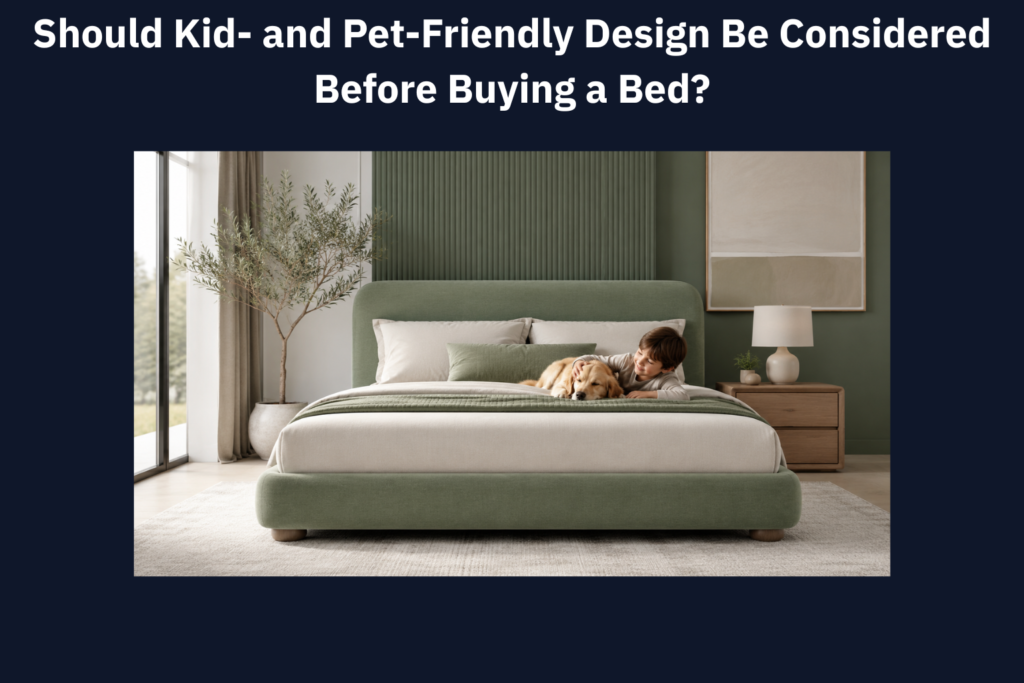
Should Kid- and Pet-Friendly Design Be Considered Before Buying a Bed?
Considering kid- and pet-friendly design before buying a bed is a proactive investment that reduces replacement costs and enhances safety, making it a necessary step for households with young children or animals.
The Practical Case for Kid- and Pet-Proof Bed Design
The practical case for prioritizing kid- and pet-friendly bed design rests on two pillars: extending the product’s useful life and maintaining a healthier sleeping environment. A bed chosen without considering these factors may need premature replacement, while a well-chosen model can provide a longer service life.
Think about the cost-per-use calculation as a hypothetical example: a bed frame that costs $800 and lasts ten years with kids and pets would be more economical than a $400 frame that needs replacement every two years after repeated accidents or damage. The up-front investment in durable materials can reduce long-term replacement costs.
Beyond the financial side, there is the health angle. A bed that resists moisture, stains, and odors supports better sleep hygiene and reduces allergen buildup. When you buy a bed for a child’s room, these factors become even more critical.
The transition from “if I should consider it” to “what should I look for” starts with understanding the most common threat: accidents.
Accidents Are a Common Bed-Damaging Event
Accidents, including spilled drinks, bedwetting, pet urine, and vomit, can damage bed frames and mattresses. An untreated accident can permanently stain a mattress, create lingering odors, and weaken some foam or wood materials over time.
Urine and moisture can penetrate unprotected foam and wood, creating odors and contributing to material damage over time. Repeated moisture exposure can weaken some foam structures and contribute to sagging or loss of support. In wood frames, prolonged moisture exposure can contribute to warping or mold growth.
A tight-weave fabric cover combined with a non-absorbent core may improve the chance of cleaning and salvaging the mattress after a significant accident. That is why a waterproof mattress protector is one of the most cost-effective investments you can make.
To be clear, most households will face a minor accident, not a catastrophic flood. But even minor spills add up over time. A bed that is designed to handle them from day one will simply last longer and smell fresher.
What Makes a Bed Frame Genuinely Kid- and Pet-Friendly?
A genuinely kid- and pet-friendly bed frame is built from materials that resist scratching, denting, and absorbing odors. Three design pillars define this category: material hardness, ease of cleaning, and structural reinforcement.
Let us examine each pillar, starting with the frame itself, then moving to the mattress cover, and finally the foam construction.
Hardwood Frames vs. Softwood Frames vs. Metal
Hardwood frames such as oak and maple generally resist denting better than many softwood frames, while coated metal frames can also resist everyday surface wear. Hardwoods have a tighter grain structure, which can make visible scoring and daily wear less pronounced.
On the Janka hardness scale, some oak species measure around 1,360, while some pine species are near 690. These values indicate relative resistance to indentation, not a direct percentage of scratch resistance. For households with large dogs or active children, the effect on long-term durability can matter.
Metal frames, while generally resistant to everyday scratching, have their own potential weakness: joint fatigue and squeaking. Over time, bolts can loosen and metal joints may develop noise. A no-squeak bed frame assembly can mitigate this, but it requires regular maintenance. As a general comparison, hardwood can offer a strong balance of durability and quietness, while metal performance depends heavily on joint design and assembly quality.
One important distinction is that “solid wood” is not the same as “engineered wood.” Lower-quality or poorly sealed MDF and particleboard can be more sensitive to moisture and edge damage than solid hardwood or powder-coated metal. Check the material grade, sealing, construction quality, and intended load before buying.
The Role of Washable, Removable Covers
A removable, machine-washable mattress cover is one of the most practical design features for managing kid- and pet-related messes. A zippered encasement cover makes the mattress easier to clean and protect.
Dirt, dander, urine, and spilled liquids stay on the cover and never reach the core foam. You simply unzip, wash, and remount. Without this feature, a single accident can permanently ruin the mattress.
Material matters here: 100% cotton or bamboo covers are often breathable but may be less stain-resistant than some synthetic blends. Polyester blends can be tougher and may resist staining better. Protection levels vary by product, seam construction, membrane design, and testing method, so verify the manufacturer’s waterproof or water-resistant rating and care instructions. For children and pets, a waterproof encasement can provide more comprehensive protection.
An “encasement” wraps the entire mattress, while a “topper” sits only on top. For full protection, choose an encasement. For detailed care, see our mattress protector care instructions.
Is There a Safety Concern with Kid- and Pet-Friendly Materials?
Safety concerns with kid- and pet-friendly beds can involve chemical emissions from some materials and physical hazards such as sharp edges or unstable slats. Materials designed for stain or moisture resistance vary widely, so product-specific testing and certifications matter.
Waterproof coatings, stain-resistant treatments, adhesives, foam emissions, and flame-retardant systems are separate material categories, and their chemical content varies by product. When possible, choose products with clear material disclosures and verified third-party testing.
VOCs, Flame Retardants, and “Waterproof” Treatments
Some products may emit volatile organic compounds or use chemical treatments that households may prefer to limit. The level of concern depends on the specific substance, emission level, exposure conditions, and testing criteria. Chemical content varies by product and market, so do not assume that every waterproof layer uses the same substances.
The logic is straightforward: a low-VOC mattress that gets ruined by a single accident is a poor trade-off. But a mattress treated with harsh chemicals is also unhealthy. The solution lies in third-party certifications.
Greenguard Gold focuses on defined chemical-emission limits, while OEKO-TEX Standard 100 evaluates textiles for specified harmful substances. These certifications address different criteria, so review what each label covers when shopping for a certified non-toxic mattress.
Households with sensitive occupants may place greater importance on verified low-emission materials. A certified mattress can be a strong purchasing consideration, but certification should be reviewed alongside the product’s full material disclosure. Remember: “waterproof” does not mean “chemical-free.” Always verify what the certification covers.
How to Balance “Beautiful” with “Durable” in Your Bedroom
Balancing a beautiful aesthetic with kid- and pet-durability requires focusing on fabric choice (performance fabrics) and finish selection (matte over high-gloss). You do not have to sacrifice style for resilience; you just need to choose smarter.
Many homeowners worry that “durable” means “ugly.” That is no longer true. Modern performance fabrics and matte finishes deliver both beauty and brawn. Let’s look at the fabric choice first.
Performance Fabrics vs. Pure Cotton or Linen
Performance fabrics, including products sold under names such as Crypton or Sunbrella, are engineered for easier cleaning and stain resistance, but construction and treatment methods vary by product. Some use tight weaves, protective finishes, or barrier systems that help liquids bead or remain on the surface longer.
High thread-count cotton can look beautiful and feel luxurious, but it may absorb liquids quickly and can be harder to clean if spills are not treated promptly. Linen may also absorb liquids readily, depending on its finish and construction.
The trade-off is cost: performance fabrics can be more expensive upfront. Durable upholstery may reduce cleaning difficulty and visible wear, but it does not replace a separate mattress protector where mattress protection is needed. Browse our selection of performance fabric bed frames for options that combine style with resilience.
One caveat: “stain-resistant” is not “scratch-proof.” Performance fabric can still be punctured by sharp claws. For homes with cats, pairing performance fabric with a sacrificial throw blanket is a smart strategy.
The Kid/Pet-Friendly Bedroom: A Pre-Purchase Audit
Before buying your next bed, use this simple audit to evaluate how well it will survive a normal household with kids and pets. Answer each question honestly to avoid costly regrets.
☐ Pre-Purchase Checklist
Final Verdict: Should You Delay Buying a Bed Until You Find a “Kid/Pet-Friendly” Model?
You should not delay buying a bed indefinitely, but you should actively filter your options for the non-negotiables of solid material, washable cover, and safe certifications. The perfect bed for a household with kids and pets exists; you just need to know what to look for.
Here is the bottom line: a slightly more expensive, durable frame can be better value if it lasts longer and needs fewer repairs or replacements. For example, a $1,000 bed lasting ten years would cost less per year than a $500 bed replaced every three years, but actual lifespan depends on construction, use, care, and warranty.
Use the checklist above when you shop. Prioritize solid hardwood or powder-coated metal, a removable waterproof cover, and relevant Greenguard Gold or OEKO-TEX certification, while also checking dimensions, support compatibility, load capacity, maintenance needs, and warranty terms.
Your bed is one of the most important purchases for your home. Make it one that can handle the beautiful chaos of family life.

Mohamed Abdirahman Camay is the founder and lead content specialist at BedLuFix. He researches bed types, bed frames, mattress compatibility, sleep comfort, support systems, bedroom layouts, and key bed-buying factors. His research process includes reviewing manufacturer specifications, comparing product features and materials, and analyzing common consumer questions. He also develops practical bed calculators, comparison tools, checklists, and templates that simplify bed selection and bedroom planning. Mohamed creates clear guides and useful resources to help readers choose beds that suit their sleep needs, room size, lifestyle, and budget.