Should Headboard and Footboard Options Affect Bed Choice? A Practical Decision Guide
Headboard and footboard options should affect bed choice when they change room fit, seated comfort, mobility, storage access, maintenance, budget, or design coherence. Prioritise practical fit before style.
These features can make a bed easier to use and better suited to a bedroom. They can also add size, cost, assembly work, and visual weight. Their value depends on what you need from the bed.
Start with the practical questions. Will the complete frame fit the room? Can you open drawers and doors? Do you sit up in bed? Do you want an open mattress edge? Once those needs are clear, style becomes easier to judge. It also helps to compare bed frame types before choosing decorative features.
What Role Do Headboards and Footboards Actually Play in a Bed?
Headboards and footboards can serve protective, practical, structural, and decorative roles, but their exact function depends on the bed’s design and construction.
Some beds use both boards as integrated frame components. Other beds use an independent base and treat the headboard as an optional attachment. Many modern beds do not require a footboard at all. This means you should judge the complete product instead of assuming that every headboard or footboard performs the same job.
Headboard Functions: Wall Protection, Seated Comfort, and Visual Focus
A headboard can protect the wall, provide a surface for sitting up, and create a visual focus behind the bed.
The wall-protection benefit depends on the headboard’s width, height, material, and position. A wide headboard can shield the wall from contact near the pillows. A narrow or low design covers less of the wall. A gap between the bed and wall may also reduce this benefit.
For people who read, watch television, or work in bed, the headboard can provide a surface to lean against. Comfort depends on its height, angle, firmness, padding, and the pillows used with it. An upholstered headboard may feel softer than a metal or slatted design, but no material guarantees comfort for every person.
The headboard also gives the bed a clear visual centre. Upholstery can add softness and colour. Wood can connect the bed with cabinets or bedside tables. Metal and slatted designs can create a lighter appearance. These are design effects, not evidence that the headboard changes sleep quality or provides medical back support.
Footboard Functions: Structural, Visual, and Practical
A footboard can complete the bed’s design, hold bedding near the mattress edge, and form part of the frame structure when the manufacturer integrates it into the bed.
On some traditional frames, the footboard connects to the side rails and forms part of the bed’s structure. Other frames use a platform, central beam, legs, or another independent support system. In those designs, a footboard may be decorative rather than structural.
Height and shape change how the footboard feels in daily use. A low or open design keeps the bed end visually open. A high or closed design creates a more enclosed appearance and may help keep a duvet near the mattress. It may also prevent a tall sleeper’s feet from extending beyond the mattress edge.
A footboard does not shorten the mattress. It only changes access to the end and the space available beyond the mattress edge. This distinction matters for tall sleepers and anyone who prefers an open bed end.
These functions create the first purchase criteria. You need to decide which benefits apply to your room and which features would add unnecessary size or complexity.
When Headboard and Footboard Options Should Influence Your Bed Choice
Headboard and footboard options become important when they affect room fit, storage access, seated comfort, movement, installation, or the bedroom’s intended style.
Use the following situations to assess your own needs. A feature that matters in one room may have little value in another.
Room Size and Wall Placement
In a small bedroom, the height and depth of a headboard or footboard can affect visual scale, walking space, door movement, and furniture placement.
Do not measure only the mattress. Measure the bed’s complete external width, length, and height. A thick headboard can increase the distance between the mattress and wall. A footboard can extend the frame beyond the mattress and reduce the open space at the bed end.
Check the full walking route around the bed. Include the movement of the bedroom door, wardrobe doors, storage drawers, and nearby chairs. Note the location of windows, outlets, switches, skirting boards, and wall fittings. These details can affect how closely a headboard sits against the wall.
A tall headboard may emphasise the vertical area behind the bed, but the result depends on ceiling height and surrounding furniture. It may suit a large blank wall and feel dominant in a smaller room. There is no universal visual rule, so compare the outline with the actual space.
A simple test helps. Mark the expected headboard width and height on the wall with removable tape. Mark the footboard position on the floor. You can then see the bed’s complete footprint before you buy it.
Storage and Bed Frame Integration
Headboards and footboards affect storage only when their position or integrated design changes access to drawers, shelves, lift-up bases, or under-bed containers.
A footboard may block storage access from the bed end, but side access may remain open. Side drawers need enough room to extend. End drawers need clear space beyond the footboard. A lift-up base needs space above the mattress platform and a safe movement path.
A storage headboard can add shelves, cabinets, lights, or charging access. These features may reduce the need for a bedside table, but they can also make the bed deeper. You should check whether shelves remain reachable and whether cabinet doors can open without hitting the wall or nearby furniture.
Platform beds do not automatically provide more storage. Some have drawers or open space below them. Others have a solid base or very little under-bed clearance. Compare the actual storage design rather than relying on the frame name.
If storage is a main priority, review the available bed storage options and measure every opening path before choosing the boards.
Style Consistency and Room Theme
Headboard and footboard style becomes more important when the bedroom follows a defined design direction or contains furniture with strong visual features.
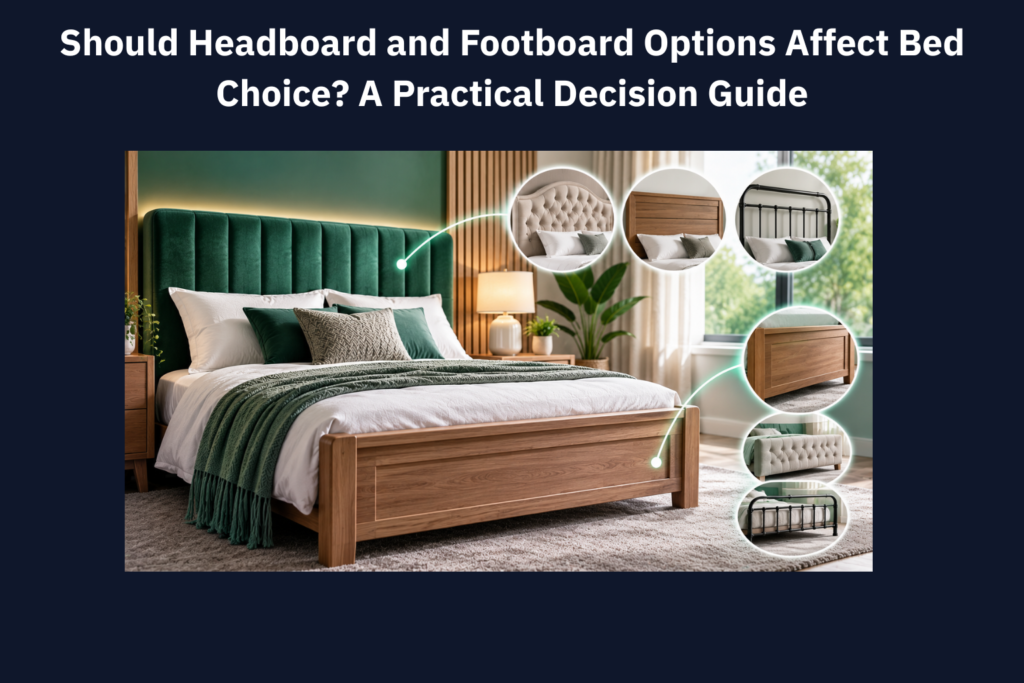
A full headboard and footboard set creates a stronger bed silhouette than a low-profile frame. Curved wood, buttoned upholstery, metal scrollwork, straight panels, and slim slats each create a different visual effect. The right choice depends on the room you already have and the result you want.
Matching does not require every piece to use the same colour or material. You can connect the bed with other furniture by repeating one feature, such as a wood tone, fabric colour, metal finish, or line shape. You can also mix modern and traditional pieces when one repeated feature keeps the room connected.
Treat these ideas as flexible design guidance. Room cohesion is partly subjective. A contrasting headboard can be intentional, while an exact furniture set may feel too uniform for some people.
Sleeping Comfort: Tall Individuals and Seated Back Comfort
Tall sleepers may find a high or closed footboard restrictive when they extend beyond the mattress edge, while people who sit up in bed may prefer a suitable padded headboard.
Start with mattress fit. Compare your height and sleeping position with the mattress length. If your feet normally reach or pass the mattress edge, a high footboard may feel restrictive. A low or open footboard may create more freedom without changing the mattress dimensions.
If you sit up in bed, check where the headboard meets your body. Its useful height must remain visible above the mattress and pillows. Padding should feel comfortable, while the mounting should remain stable. A headboard that looks soft may still feel awkward if it is too low, too upright, or far behind the pillows.
Test the position when possible. Sit against the display bed with the pillows you normally use. Then lie in your usual sleeping position and check the space near the footboard. This test measures personal comfort. It does not show that the bed provides a medical benefit.
Scenarios Where Headboard and Footboard Options Are Less Important
Headboard and footboard options can receive lower priority when budget, flexibility, easy movement, or a simple frame matters more than decorative features.
In these situations, frame stability, mattress fit, room clearance, and practical use should guide the purchase first.
Budget-First Purchases
Budget-first buyers can treat headboards and footboards as optional when a stable frame and suitable mattress already meet their main needs.
Compare the complete delivered cost, including hardware, delivery, assembly, and optional accessories. A simple frame may cost less than a decorative set, but this is not guaranteed. Material, construction, brand, and bed size can change the price.
Buying a simple compatible frame may allow you to add a headboard later. Confirm the attachment method before relying on this option. Do not assume that bolt positions or widths are standard across products.
Platform Beds with Separate Headboards
A platform bed with a separate headboard allows you to choose the frame and visual feature independently.
This approach can help when you like the support system of one bed but prefer a different headboard. Options include wall-mounted, freestanding, and frame-mounted headboards. Each type requires different checks.
Measure the frame and headboard width. Check the attachment points, wall type, skirting boards, and required hardware. A separate headboard is flexible only when its dimensions and mounting system suit the room and frame.
Convertible Beds
Headboard and footboard style becomes less important when the bed must convert, fold, expand, or serve more than one function.
Daybeds, sofa beds, folding beds, and other convertible designs need a clear movement path. A fixed board may support one product’s operation and interfere with another. Follow the manufacturer’s opening, folding, and clearance instructions for the exact model.
Prioritise easy conversion, safe movement, and access to the mechanism. Decorative features should not make the main function harder to use.
Modular Frames
Modular frames reduce the need to decide on every headboard or footboard feature during the initial purchase.
Some systems let you add, remove, or replace components. This can help if your room, style, or needs may change. However, future compatibility is not guaranteed.
Check the exact frame model, mounting hardware, available finishes, warranty terms, and current accessory range. A manufacturer may change its product line, so do not assume that the same components will remain available later.
How to Match Headboard and Footboard Style to Your Bedroom
Matching headboard and footboard style to a bedroom requires attention to material, colour, shape, height, and the visual weight of existing furniture.
Use three steps. First, identify the room’s strongest visual features. Second, choose a compatible material or finish family. Third, select a height and shape that fit the wall and surrounding furniture.
Material Choices
Headboard and footboard materials influence texture, maintenance, visual weight, and how easily the bed coordinates with other furniture.
Upholstered designs can add softness and colour, but fabric care and dust removal matter. Wood can connect with cabinets, doors, or flooring, though different wood finishes may not match exactly. Metal can create a slim outline, while rattan and mixed materials can add visible texture.
Consider cleaning access, exposed joints, fabric-care instructions, and the number of surfaces that collect dust. Construction quality matters more than a simple material label. Do not assume that one material is always lighter, stronger, or more durable.
You can combine different materials by repeating a colour, finish, or shape. For example, a simple upholstered headboard can work with a traditional wood footboard when the fabric colour connects with the wood tone or nearby furniture.
Height Proportions
Headboard and footboard height should suit the wall, mattress position, ceiling, bedside furniture, and the amount of visual emphasis you want.
Include mattress height in the comparison. A thick mattress and several pillows can hide part of a low headboard. A tall headboard can provide more visible surface, but it also increases visual weight.
A high footboard creates a more enclosed bed silhouette. A low footboard keeps the end more open. Neither option is automatically better. The choice depends on body fit, room size, and visual preference.
Use the product’s actual dimensions. Mark the outline on the wall and floor before purchasing. Avoid universal height ratios because rooms, mattresses, and furniture vary.
Color Coordination
Headboard and footboard colour can coordinate with the room through close matching, repeated accents, or intentional contrast.
Close matching uses similar colours and finishes for a calm, connected look. Tonal coordination uses lighter and darker versions of the same colour family. Contrast uses a different colour to make the bed a stronger focal point.
Compare samples under the room’s real lighting. Wood finishes with similar names can still look different. Fabric can also change appearance under warm, cool, natural, or artificial light.
When using contrast, repeat the headboard or footboard colour in one or two nearby elements, such as a cushion, lamp, rug, or artwork. This can connect the bed with the room without requiring an exact furniture set.
Practical Trade-Offs: Full Headboard and Footboard vs Platform vs Board-Free
Choosing between a full headboard and footboard, a headboard-only platform bed, and a board-free low-profile frame involves trade-offs in fit, access, assembly, maintenance, cost, and visual presence.
The table shows common tendencies. It does not replace the product’s dimensions, assembly instructions, storage design, or complete price.
| Feature | Full Headboard and Footboard | Headboard-Only Platform Bed | Board-Free Low-Profile Frame |
|---|---|---|---|
| Wall protection | A headboard may protect the wall, depending on its size and placement. | A headboard may protect the wall, depending on its size and placement. | Requires wall clearance, a separate wall protector, or a separate headboard if protection is needed. |
| Seated comfort | Depends on headboard height, shape, padding, and mounting. | Depends on headboard height, shape, padding, and mounting. | No built-in surface for leaning unless a separate headboard is added. |
| Bed-end freedom | A high or closed footboard may prevent feet or bedding from extending beyond the mattress edge. | No attached footboard usually leaves the mattress edge open. | The mattress edge normally remains open. |
| Storage access | Depends on whether storage opens from the sides, end, or top. | Depends on base clearance, drawers, or lift-up design. | Depends on base clearance and support construction. |
| External dimensions | Boards may increase the total length or depth of the bed. | The headboard may increase depth. | Often visually compact, but actual dimensions require verification. |
| Assembly | May involve more components and attachment points. | Varies according to the platform and headboard design. | May involve fewer components, depending on construction. |
| Cost | Compare the complete product price, delivery, and assembly. | Compare the complete product price, delivery, and assembly. | Do not assume it is cheaper without comparing equivalent products. |
| Visual presence | Often creates a defined or traditional bed silhouette. | Often creates a balanced focal point with an open bed end. | Creates a simple and visually open profile. |
| Maintenance | More joints and surfaces may require inspection or cleaning. | Maintenance depends on the headboard material and platform structure. | Fewer decorative parts may simplify cleaning, but construction still matters. |
Use the table to remove options that conflict with your needs. Then compare the remaining products by their complete dimensions and construction.
Decision Framework: A Step-by-Step Approach to Choosing Your Bed
To decide whether headboard and footboard options should affect your bed choice, follow five steps: measure, prioritise, match, price, and test.
Before paying, check return terms, attachment compatibility, included hardware, and assembly requirements. These details can matter more than the feature name used in a product listing.
Final Verdict: Should Headboard and Footboard Options Affect Your Choice?
Headboard and footboard options should affect your bed choice when they support your room layout, seated comfort, storage access, mobility, budget, and design priorities.
The answer is yes when the features serve your main needs. A suitable headboard may protect the wall, provide a surface for sitting up, and create a visual centre. A footboard may complete the design or form part of the frame, but a high design can limit access beyond the mattress edge.
The answer is no when these features add cost, size, or complexity without solving a practical problem. In that case, focus on frame stability, mattress fit, room clearance, flexibility, and the complete price.
Review the five-step checklist. Measure the room and the bed’s complete external dimensions. Then choose the simplest headboard and footboard arrangement that meets your priorities.
References
Bed Advice UK. Buying a bed that’s right for you.
Sleep Foundation. Mattress Sizes 101: Finding Your Perfect Fit.
IKEA. How to choose a bed frame.

Mohamed Abdirahman Camay is the founder and lead content specialist at BedLuFix. He researches bed types, bed frames, mattress compatibility, sleep comfort, support systems, bedroom layouts, and key bed-buying factors. His research process includes reviewing manufacturer specifications, comparing product features and materials, and analyzing common consumer questions. He also develops practical bed calculators, comparison tools, checklists, and templates that simplify bed selection and bedroom planning. Mohamed creates clear guides and useful resources to help readers choose beds that suit their sleep needs, room size, lifestyle, and budget.