
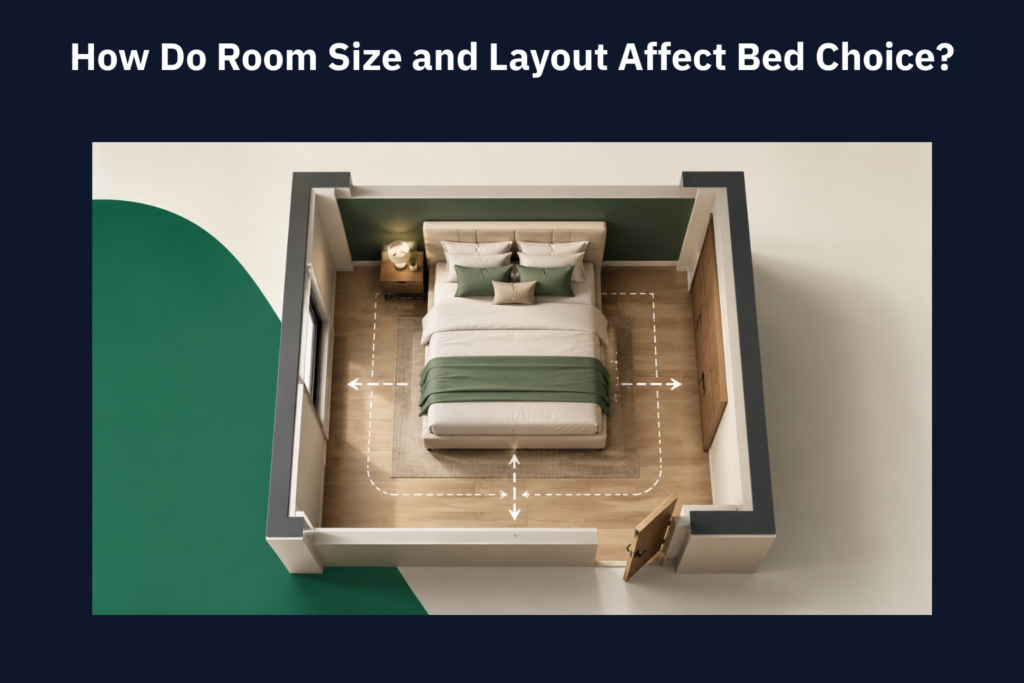
How Do Room Size and Layout Affect Bed Choice? (A Practical Space Guide)
Choosing the wrong bed size can make an otherwise perfect bedroom feel cramped and unusable. You must maintain an open clearance boundary around your sleeping area. A well-planned footprint protects your bedroom’s daily function and safe movement.
Before measuring your walls, you must understand why space planning acts as the foundation of your bedroom design.
Why Room Size and Layout Dictate Your Bed Choice
Your physical floor footprint dictates every step of your bedroom layout planning. Analyzing several buying factors ensures that your final bedroom layout remains practical and comfortable.
Clearance boundary: The designated empty walking zone around a bed frame needed to navigate the bedroom safely.
- Rule: Maintain at least $30 \text{ inches}$ of walking clearance around the sides and foot of the bed frame (Residential Space Planning Council (External, 2026)).
- Reason: This clearance boundary ensures that closet doors, entryways, and walking paths remain fully functional.
- Example: Placing a King mattress in a $10 \times 10 \text{ foot}$ room leaves only $12 \text{ inches}$ of clearance on each side, blocking drawers and paths.
Reality Check: $10 \times 10 \text{ Room}$ Layout Comparison
Infographic Diagram Explanation: This comparison illustrates how a Queen bed maintains a safe $30\text{-inch}$ walking clearance in a $10 \times 10 \text{ foot}$ room, while a King bed shrinks the pathway to just $12 \text{ inches}$, obstructing door swings and dresser access.
Balancing visual weight (the bulk of the bed frame) with visual balance preserves an open layout. Layout choices remain dependent on individual traffic flow; a $30\text{-inch}$ path may not fit every master bedroom flawlessly.
Source: Residential Space Planning Council (External, 2026) spatial guidelines.
Once you understand why spatial clearance matters, you can examine the specific structural variables that create your bedroom’s footprint.
What Room Size and Layout Factors Affect Bed Choice?
An accurate room-to-bed fit requires mapping every physical variable in your bedroom.
Floor footprint: The total two-dimensional square footage of a room before accounting for vertical space or furniture placement.
Bedroom Clearance Anatomy Blueprint
Infographic Diagram Explanation: This top-down blueprint highlights essential bedroom clearance zones. It visually maps the $36\text{-inch}$ blue extension area required for opening dresser drawers and the $30\text{-inch}$ green walking boundary needed around the bed frame.
Neglecting a single obstacle ruins traffic flow. Room dimensions, walking clearance, door swing, window placement, closet access, and furniture footprint dictate successful planning.
| Layout Factor | What to Check | Good Sign | Warning Sign |
|---|---|---|---|
| Walking Clearance | Path around the bed | $30 \text{ inches}$ or more of open space | Tight side paths below $24 \text{ inches}$ |
| Door Swing Clearance | Entry, closet, and en-suite doors | Doors swing open fully without contact | Doors collide with bed frame or furniture |
| Furniture Footprint | Dressers, wardrobes, and desks | Drawers and doors open completely | Bed blocks access to storage drawers |
| Window Placement | Headboard and natural light | Headboard sits below or beside trim | Frame blocks light or emergency egress |
| Outlet Access | Wall outlets near the headboard | Outlets remain reachable for chargers | Bed frame completely covers power points |
| Traffic Pathway | Route from door to closet/bath | Direct, unhindered pathways | Path requires navigating tight corners |
Source: Adapted from Residential Space Planning Council (External, 2026) spatial guidelines.
With these architectural factors defined, the next logical step is learning how to measure them accurately.
How to Measure Your Bedroom Layout for Accurate Bed Choice
Precise measurements prevent costly delivery regrets and layout errors.
Traffic pathway: The primary walking routes used to navigate between the bedroom entryway, bed, closet, and bathroom.
- Measure Wall-to-Wall Dimensions: Run a tape measure along the baseboards to record the exact width and length of your room footprint in inches.
- Account for Architectural Obstacles: Draw the swing paths of closet doors, entryways, and the height of windowsills on a paper sketch.
- Factor in Secondary Furniture Footprints: Measure the depth and width of your existing dressers, nightstands, and desks, allowing for open drawer space.
Source: Residential Space Planning Council (External, 2026) for residential measurement techniques.
After recording your physical room dimensions, you can compare these numbers directly against standard bed sizes.
Compare Common Bed Sizes Against Standard Room Dimensions
Selecting the correct mattress dimensions requires matching your floor area to standard bed sizes. Bed size should be checked against standard mattress dimensions before planning the final bedroom layout.
Furniture footprint: The physical floor area occupied by secondary items such as dressers, nightstands, and desks.
King and California King models require strict separation due to distinct dimensional layouts.
| Bed Size | Mattress Dimensions | Minimum Room Size Required | Recommended Layout Space Left | Best Suited For |
|---|---|---|---|---|
| Twin / Twin XL | $38 \times 75 \text{ inches}$ to $38 \times 80 \text{ inches}$ | $7 \times 10 \text{ feet}$ | High clearance; fits desk and dresser easily | Studio apartments, children’s rooms, daybeds |
| Full / Double | $54 \times 75 \text{ inches}$ | $10 \times 10 \text{ feet}$ | Moderate clearance; fits $1\text{ to }2$ small dressers | Single sleepers, guest rooms, compact layouts |
| Queen | $60 \times 80 \text{ inches}$ | $10 \times 12 \text{ feet}$ | Standard clearance; accommodates two nightstands | Couples, standard master bedrooms, balanced layouts |
| King | $76 \times 80 \text{ inches}$ | $12 \times 12 \text{ feet}$ | High visual weight; limits extra secondary furniture | Spacious master suites, wide-footprint layouts |
| California King | $72 \times 84 \text{ inches}$ | $12 \times 12 \text{ feet}$ | Generous side paths; fits narrower and longer rooms | Tall sleepers, elongated bedroom layouts |
Source: Mattress dimensions sourced from Bedlufix Mattress Dimension Guide (Internal, 2026); room dimensions sourced from Residential Space Planning Council (External, 2026).
Understanding these general sizes prepares you to tackle the specific architectural challenges of your room’s shape.
Map Your Bed Selection to Specific Bedroom Layout Challenges
Standard sizes do not always match complex structural layouts. Space optimization helps small bedrooms preserve walking clearance without sacrificing practical sleeping space.
Visual weight: The perceived heaviness of an object based on its size, color, or bulk relative to the surrounding space.
Ensure the bed choice leaves enough empty wall and floor space so the room does not feel crowded.
Square Room
Center on solid wall for equal side pathways.
Narrow Room
Anchor on short wall to open up floor space.
Multi-Door
Keep bed clear of the primary egress path.
Infographic Diagram Explanation: These layout mini-maps demonstrate how to adapt bed placement based on room shape. Square rooms benefit from central anchoring, narrow rooms require short-wall placement, and multi-door rooms must prioritize keeping the main egress paths completely clear.
How to Place Beds in Small Square Bedrooms
If Room is a small square ($10 \times 10 \text{ feet}$) → Do Place the bed centered on the main solid wall (opposite or adjacent to the door) to maximize symmetrical side clearance → Result Preserves traffic flow on both sides of the bed without crowding the bedroom footprint.
Positioning Beds in Narrow or Rectangular Rooms
If Room is narrow and long ($9 \times 14 \text{ feet}$) → Do Push the bed headboard against the shorter wall, or anchor it lengthwise to establish a distinct sleeping zone → Result Opens up a clear floor pathway for comfortable daily movement.
Balancing Beds in Multi-Door or High-Window Layouts
- Rule: Never block main exits, air vents, or natural walking paths.
- Reason: It reduces safe movement, airflow, and daily room function (National Fire Protection Association (External, 2025)).
- Example: Anchor your bed using a low-profile headboard that sits safely below window trim to retain natural light and air circulation.
Source: Residential Space Planning Council (External, 2026) and National Fire Protection Association (External, 2025).
Even if you place the bed correctly, you must still avoid common placement errors that block furniture and movement.
Avoid Bed Layout Mistakes That Ruin Traffic Flow
Many homeowners commit costly furniture-buying mistakes during the layout planning stages. Storage options should be planned with drawer extension space so dressers, wardrobes, and under-bed storage remain usable.
Drawer extension clearance: The physical space required in front of storage furniture to fully open drawers and stand comfortably.
-
Pitfall 1: Ignoring Drawer Extension Space.
- Consequence: Placing a bed too close to a dresser prevents drawers from opening, leaving storage unusable.
- Correction: Maintain a minimum of $36 \text{ inches}$ of drawer extension clearance in front of all storage furniture (Furniture Manufacturer Space Guidelines (External, 2026)).
-
Pitfall 2: Centering a Bed in an Asymmetrical Room.
- Consequence: Positioning a bed in the absolute center of an asymmetrical space creates chopped-up, useless pockets of floor space.
- Correction: Use asymmetrical layout zones by offsetting the bed to one side to establish a unified reading nook or desk area.
Source: Furniture Manufacturer Space Guidelines (External, 2026).
To condense these diverse spatial metrics, consult the comprehensive attribute summary below.
Room Size and Layout Attribute Table
This summary table condenses the technical clearances required for an optimal bedroom layout.
Door swing arc: The radial path a door travels as it opens from a closed to a fully open position.
| Attribute | Value or Explanation |
|---|---|
| Room size | The wall-to-wall dimensions that define available floor space. |
| Walking clearance | The open space around the bed used for movement, recommended at $30 \text{ inches}$ or more. |
| Door swing clearance | The space required for doors to open fully without hitting furniture. |
| Drawer extension clearance | The open area of $36 \text{ inches}$ required in front of dressers and wardrobes for functional access. |
| Furniture footprint | The physical floor area occupied by each furniture item, including nightstands and desks. |
| Traffic pathway | The designated route people use to move naturally through the bedroom. |
| Egress path | The clear, unobstructed safety route leading from the bed area directly to the room exit. |
| Painter’s tape mockup | A physical floor outline used to test and verify bed fit before purchase. |
Source: Adapted from Residential Space Planning Council (External, 2026) and National Fire Protection Association (External, 2025) safety standards.
With these metrics established, you are ready to physically verify your choice using a real-world tape test.
How to Verify Your Bed Choice Matches Your Room Layout
Before completing your bed purchase, perform a physical verification on your bedroom floor.
Painter’s tape mockup: A physical layout planning technique where you outline furniture dimensions on the floor using low-tack tape.
Infographic Diagram Explanation: Using blue painter’s tape to outline your planned bed footprint on the floor allows you to physically test door swings, verify walking pathways, and check furniture clearances in real-time before making a purchase.
Source: Practical Furniture Planning Guidance (External, 2026).
If you still have lingering doubts about specific room dimensions, read our quick-reference answers below.
Quick Answers About Room Size and Layout Before Choosing a Bed
These fast answers address the most common spatial challenges faced by mattress buyers.
Egress path: The safe, unobstructed escape route leading from the sleeping area directly to the main room exit.
What is the best bed size for a small bedroom?
For small bedrooms measuring $9 \times 10 \text{ feet}$ or less, a Twin XL or Full bed is the best choice. These sizes provide sufficient sleeping space while leaving the recommended $30\text{-inch}$ walking clearance for traffic flow and secondary furniture (Residential Space Planning Council (External, 2026)).
How much walking clearance should a bed have?
A bed should have at least $30 \text{ inches}$ of walking clearance around the sides and foot. This boundary ensures that walkways remain open, doors swing freely, and drawers extend completely without forcing awkward physical maneuvers (Residential Space Planning Council (External, 2026)).
Can a King bed fit in a 10 x 10 room?
A standard King bed physically fits in a $10 \times 10 \text{ foot}$ room but creates poor clearance. It leaves only $12 \text{ to } 18 \text{ inches}$ on the sides, blocking closet access and dresser drawers while making the bedroom feel cramped (Residential Space Planning Council (External, 2026)).
How do I measure my room before buying a bed?
Measure wall-to-wall dimensions using a tape measure, then subtract the swing paths of all doors and the footprints of other furniture. The remaining space dictates the maximum usable area available for your bed frame footprint (Residential Space Planning Council (External, 2026)).
Why does drawer clearance matter in bedroom layout?
Drawer clearance is critical because storage furniture requires at least $36 \text{ inches}$ of open space to pull drawers out fully and stand comfortably. Neglecting this measurement leads to blocked dresser drawers, rendering your storage completely unusable (Furniture Manufacturer Space Guidelines (External, 2026)).
How do I test bed placement before delivery?
Outline the exact dimensions of your planned bed frame on the bedroom floor using low-tack painter’s tape. Walk around the taped boundary to test door swing clearance, drawer extension space, and the overall traffic pathway flow (Practical Furniture Planning Guidance (External, 2026)).
Using these answers to finalize your bedroom plan allows you to make your purchase with absolute confidence.

Mohamed Abdirahman Camay is the founder and lead content specialist at BedLuFix. He researches bed types, bed frames, mattress compatibility, sleep comfort, support systems, bedroom layouts, and key bed-buying factors. His research process includes reviewing manufacturer specifications, comparing product features and materials, and analyzing common consumer questions. He also develops practical bed calculators, comparison tools, checklists, and templates that simplify bed selection and bedroom planning. Mohamed creates clear guides and useful resources to help readers choose beds that suit their sleep needs, room size, lifestyle, and budget.