
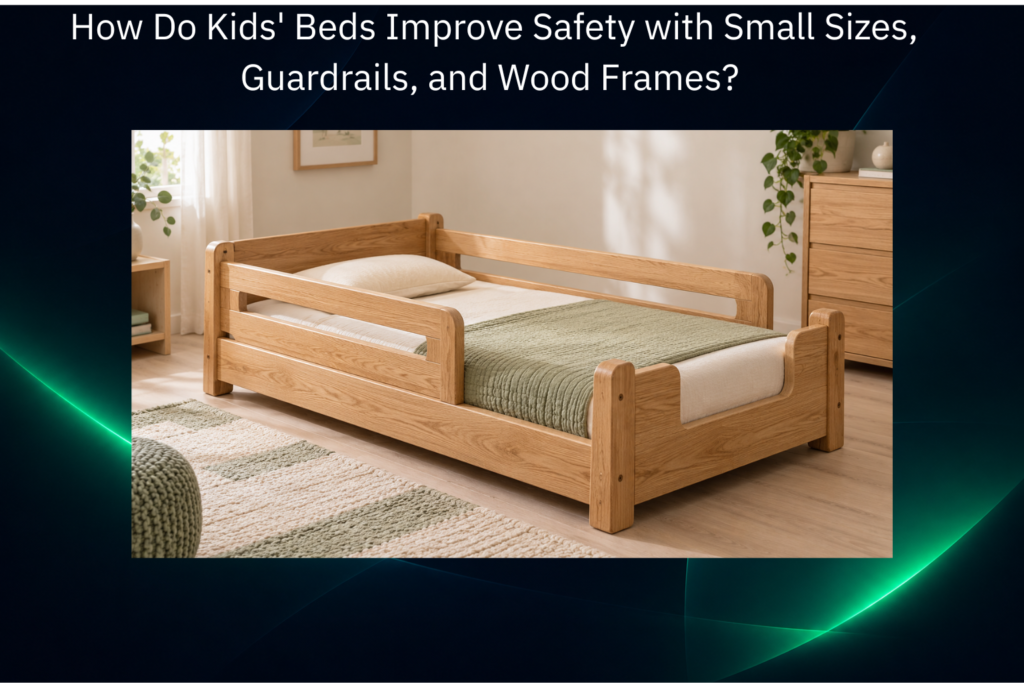
How Do Kids’ Beds Improve Safety with Small Sizes, Guardrails, and Wood Frames?
Kids’ bed safety depends on age-appropriate dimensions, compatible mattresses, suitable guardrails where required, and a stable frame assembled and used according to the manufacturer’s instructions.
Moving from a crib to another bed changes how a child can enter, leave, and move around the sleeping area. Parents need to check more than bed size: mattress-to-frame gaps, the intended age and weight range, protective features, and nearby bedroom hazards all matter.
This guide explains the main children’s bed designs and gives practical steps for selecting, setting up, and checking one before use.
Why Kids’ Bed Safety Matters When Choosing a Bed
Kids’ bed safety matters because unsuitable dimensions, hazardous gaps, missing or incorrect protective features, and unstable construction can expose children to falls, entrapment, or furniture-related injuries.
A smaller version of an adult bed is not automatically appropriate for a child. The relevant risks depend on the child’s abilities, the product design, and how the bed is assembled and positioned.
Three hazards deserve particular attention:
- Rolling out: A child can be injured when falling from an elevated sleeping surface. Bed height, available guards, and the area around the bed affect the circumstances of a fall.
- Structural failure: Damaged components, incorrect assembly, or loading beyond the intended use may compromise a frame or mattress support.
- Entrapment: Openings between a mattress, frame, rail, or nearby structure can trap a child’s body. Some openings create serious suffocation or injury hazards.
The U.S. Consumer Product Safety Commission (CPSC) specifically identifies entrapment risks in its toddler-bed guidance. A bed that looks secure still needs to meet its applicable design and installation requirements.
What Safety Features Should You Look for in Kids’ Beds?
Important kids’ bed safety features include documented weight capacity, suitable surface finishes, securely fitted hardware, appropriate mattress support, and guardrails where the bed design requires them.
Start with the product instructions. Check the specified mattress dimensions, thickness, intended age range, rated load, assembly steps, and any safety warnings. Products described as toddler beds, bunk beds, and portable bed rails do not necessarily follow the same requirements.
A manufacturer’s weight capacity is the maximum load stated for its intended conditions of use. It should not be interpreted as permission for jumping or rough play. The material or thickness of a frame cannot substitute for the manufacturer’s rating.
Look for complete, correctly engaged fasteners; appropriately supported slats; stable joints; and a mattress that stays within its designated support area.
Inspect the finish and seek relevant product safety or emissions documentation rather than assuming that a natural-looking surface is automatically safe. Stop using a bed if structural parts are missing, damaged, or cannot be secured as directed.
In the United States, the CPSC’s toddler-bed guidance defines the regulated product category and describes its intended-use conditions. Those conditions should not be automatically applied to other bed categories.
What Are the Main Types of Kids’ Beds?
Montessori-style floor beds, daybeds, toddler beds, and house beds use different structures and access arrangements, so their suitability depends on the child’s developmental readiness and the exact product design.
How Montessori Beds Encourage Independent Bed Access
Montessori-style floor beds use a low sleeping surface that may allow children who are developmentally ready to enter and leave the bed independently. Their low height changes access, but it does not make every surrounding hazard disappear.
Because a child can leave the sleep surface freely, assess the whole room. Secure unstable furniture, manage electrical cords and window coverings, and remove objects that present age-related hazards. The word Montessori describes an educational approach, not a guarantee that a particular bed meets a safety standard.
A floor bed should not be treated as an ordinary infant sleep substitute. The CPSC recommends compliant cribs, bassinets, and play yards for infant sleep.
How Daybeds Combine Seating and Sleeping for Kids
Daybeds combine a sleeping platform with back or side framing that may also support daytime seating, depending on the model. They can be useful when one room serves more than one purpose, but their side panels do not automatically function as protective rails.
Check the manufacturer’s intended users, mattress requirements, frame stability, and spaces around the back and side panels. An incompatible mattress can leave openings that were not part of the product’s intended configuration.
How Toddler Beds Support the Transition From Cribs
Toddler beds are designed for children transitioning from cribs and commonly use low frames with protective features intended for the product’s specified age and use conditions.
Some toddler beds are built to accommodate a full-size crib mattress. In the United States, the CPSC describes toddler beds as intended for children at least 15 months old and weighing no more than 50 pounds, under the product category defined by its regulation. These are regulatory category conditions, not a universal readiness test for an individual child. Confirm the mattress and the particular product’s instructions before use. CPSC toddler-bed guidance.
A partial guardrail may help limit rolling out, but it cannot guarantee that every fall will be prevented.
How House Beds Combine Child-Friendly Designs With Low-Profile Frames
House beds combine a sleeping platform with a decorative house-shaped frame. Their roof-like structure does not itself provide added sleeping safety.
Check the strength and attachments of overhead pieces, accessible crossbars, protrusions, and possible entrapment openings. Do not allow children to climb on the decorative structure or hang objects from it unless the manufacturer explicitly permits that use. House beds vary in height, so choose according to the exact design rather than the name.
Kids’ Bed Types Comparison
| Bed Type | Main Features | Suitable Age/Stage | Safety Considerations | Best Use |
|---|---|---|---|---|
| Montessori Bed | Low or floor-level platform | Child ready for an open sleep surface; verify product suitability | Child-proof the surrounding room; confirm mattress fit | Independent bed access where suitable |
| Daybed | Sleeping deck with back or side framing | Child who meets the model’s intended-use conditions | Panel openings, support, and mattress compatibility | Shared seating and sleeping space |
| Toddler Bed | Low transitional frame; often uses an approved crib-size mattress | Crib-to-bed transition within specified conditions | Mattress fit, rail design, age and weight limits | Transitioning from a crib |
| House Bed | House-shaped decorative structure over a sleep platform | Child who meets the model’s intended-use conditions | Overhead parts, climbing, stability, and openings | Child’s room with verified product fit |
How Kids’ Bed Sizes and Mattress Fit Affect Safety
Mattress dimensions and bed-frame geometry affect safety because an incompatible mattress may leave hazardous openings or interfere with protective features.
Do not rely on a label such as Twin or crib mattress without comparing the actual mattress to the bed manufacturer’s approved dimensions and thickness. A mattress that moves excessively, leaves a concerning opening, or reduces the effective height of a required rail needs closer attention.
Mattress-Fit Inspection Table
| Mattress Compatibility Check | Good Sign | Warning Sign |
|---|---|---|
| Edge Gap | Mattress fits within the manufacturer’s stated dimensional and positioning requirements | Unapproved gaps, shifting, or exposed openings between mattress and surrounding structure |
| Height | Mattress thickness stays within the permitted range and preserves required protective height | Mattress exceeds the allowed thickness or compromises a required rail |
A quick finger-width test is not a universal substitute for the applicable product instructions or safety requirements. Do not add cushions, foam fillers, or improvised structural parts to close a hazardous gap; stop use and seek the correct manufacturer-approved solution.
How Guardrails Help Protect Children in Suitable Bed Designs
Guardrails can reduce the risk of falls in bed designs that require them, but their protective function depends on the correct rail configuration, secure attachment, mattress compatibility, and intended user.
Different protective devices serve different purposes:
- Toddler-bed guards: Built-in or manufacturer-approved protective features are designed for particular transition beds. Verify their placement, stability, and compatibility with the mattress.
- Children’s portable bed rails: These are separate devices intended for children who can enter and leave a bed unassisted. They are not for infants. Their installation and mattress fit must follow the product’s directions; incorrect rails can create entrapment hazards. See the CPSC portable bed-rail guidance.
- Bunk-bed guardrails: Upper bunks have specific requirements for guardrail positions, openings, attachment, and height relative to the mattress. In the United States, the CPSC requires the top of an upper-bunk guardrail to stand at least 5 inches above the mattress surface, along with other design requirements. See CPSC bunk-bed guidance.
A rail that looks tall enough may still be incompatible. Never substitute a portable rail for a bed component that the manufacturer requires to be integrated into the frame.
How Wood, Metal, and Engineered-Wood Frames Compare for Kids’ Bed Stability
Kids’ bed frame stability depends on construction, joinery, fasteners, product testing, intended loads, and assembly quality, not simply whether the frame uses solid wood, metal, or engineered wood.
Solid wood, engineered wood such as MDF, and metal can all be used in furniture frames. Their performance depends on the particular design, support members, connection details, manufacturing quality, and environment. An attractive or heavy frame is not automatically a safer frame.
Frame-Material Comparison Table
| Material | Structural Quality Indicators | Potential Weaknesses |
|---|---|---|
| Solid Wood | Sound members, secure joints, appropriate fasteners, and documented load rating | Splitting, moisture-related movement, or damaged joints |
| Engineered Wood (MDF) | Approved panels and connectors, sound edges, and stated product specifications | Moisture damage or weakened connections in some designs |
| Metal | Properly joined frame sections, sound welds or bolts, and documented load rating | Loose fasteners, damaged welds, corrosion, or deformation |
A finish or emissions certification, where applicable, addresses a different question from structural integrity. Check the manufacturer’s assembly instructions and product documentation rather than treating a single material label as proof of safety.
How to Choose a Kids’ Bed Based on Age, Development, and Safety Needs
Choosing a kids’ bed requires comparing the child’s age, developmental abilities, and intended use with the product’s safety specifications, mattress requirements, and protective features.
A child who can climb out of a crib, a child who needs easy access to a low surface, and an older child using a daybed may have different needs. Developmental readiness must be assessed alongside age, product warnings, weight limits, and bedroom conditions; one birthday does not decide everything.
Kids’ Bed Safety Decision Matrix
| Child’s Development | Suitable Bed Type | Mattress Fit | Guardrail Considerations | What to Verify |
|---|---|---|---|---|
| Transitioning from crib | Toddler bed or another specifically suitable design | Manufacturer-approved size and thickness | Built-in or approved features where required | Intended age, weight, readiness, and product documentation |
| Growing mobility and changing room needs | Suitable low Twin or house bed | Compatible mattress and support system | Check whether guards are required or permitted | Frame capacity, assembly, and room hazards |
| More independent child | Daybed or suitable standard bed | Compatible mattress with correct support | Follow the model’s requirements | Stable frame, intended use, and protective features |
Choose the product that meets the child’s current abilities and the exact manufacturer’s conditions, rather than expecting a bed category or style to establish suitability on its own.
How to Inspect a Kids’ Bed for Safety Before Use
Before a child uses a newly assembled bed, caregivers should check mattress compatibility, structural stability, hardware engagement, and protective features against the manufacturer’s instructions.
Start with the complete assembly manual. Confirm that all required parts are present and that the specified mattress and supports are installed correctly. A visual inspection can reveal problems, but it cannot establish formal compliance or replace required product testing.
Kids’ Bed Safety Inspection Table
| Safety Feature | What to Check | Good Sign | Warning Sign |
|---|---|---|---|
| Hardware | Bolts, screws, dowels, and connectors | All required parts present and secured as directed | Loose, missing, damaged, or protruding fittings |
| Stability | Frame alignment, support connections, and approved checks | Connections stay aligned and stable during intended use | Persistent wobble, deformation, or shifting joints |
| Slats | Required quantity, attachment, spacing, and support | Slats match the manufacturer’s arrangement | Missing, broken, loose, or displaced support members |
Do not attempt jumping, improvised impact tests, or forceful loading to prove strength. If the frame remains unstable or a structural component is damaged, stop use and contact the manufacturer for appropriate action.
What Kids’ Bed Safety and Setup Mistakes Should You Avoid?
Kids’ bed safety problems can arise from product defects, incorrect assembly, damaged or loose components, unsuitable mattresses, or hazardous room placement.
If the frame wobbles after assembly: Stop use and check the instructions, missing parts, connections, and floor placement. Tighten accessible hardware only as directed by the manufacturer. The result should be a correctly assembled product; if it remains unstable, do not put it back into use until the problem is resolved appropriately.
Good room placement: Follow the bed’s placement requirements while assessing windows, blind cords, heat sources, unsecured furniture, and objects that could fall or be pulled down.
Bad room placement: Put the sleeping surface within reach of dangling blind cords, unstable heavy furniture, hazardous window openings, or unsafe heat sources. These conditions create hazards unrelated to whether the mattress itself fits.
A bed placed against a wall is not automatically safer. The wall and frame may create an opening, or the placement may conflict with product instructions. Check the entire setup instead of applying a universal placement rule.
How to Verify Your Kids’ Bed Safety Before Use
Before your child uses a newly assembled bed, verify mattress fit, guardrail suitability, frame stability, hardware condition, room placement, and compliance with the manufacturer’s instructions.
Final Kids’ Bed Safety Verification Checklist
- Verify Mattress Fit: Confirm that mattress dimensions and thickness comply with the manufacturer’s requirements and do not create hazardous openings.
- Check Guardrails: Confirm that required guards are appropriate, correctly attached, undamaged, and installed as directed.
- Inspect Hardware: Check that all necessary screws, bolts, connectors, and dowels are present and secured correctly.
- Confirm Frame Stability: Check for wobbling, sagging, deformation, or damage; stop use if a structural problem remains unresolved.
- Evaluate Room Placement: Assess windows, blind cords, heating elements, unsecured furniture, and reachable objects.
- Review Assembly Instructions: Confirm that every assembly step and required component has been accounted for before first use.
The safest practical approach is to match the child’s current needs with a compatible mattress, appropriate protective features, a sound frame, and correct assembly—and to repeat those checks as the bed is used.
References
- U.S. Consumer Product Safety Commission (CPSC). Toddler Beds — Frequently Asked Questions.
- U.S. Consumer Product Safety Commission (CPSC). Toddler Beds — Business Guidance.
- U.S. Consumer Product Safety Commission (CPSC). Children’s Portable Bed Rails — Frequently Asked Questions.
- U.S. Consumer Product Safety Commission (CPSC). Bunk Beds — Business Guidance.
- U.S. Consumer Product Safety Commission (CPSC). Safe Sleep.

Mohamed Abdirahman Camay is the founder and lead content specialist at BedLuFix. He researches bed types, bed frames, mattress compatibility, sleep comfort, support systems, bedroom layouts, and key bed-buying factors. His research process includes reviewing manufacturer specifications, comparing product features and materials, and analyzing common consumer questions. He also develops practical bed calculators, comparison tools, checklists, and templates that simplify bed selection and bedroom planning. Mohamed creates clear guides and useful resources to help readers choose beds that suit their sleep needs, room size, lifestyle, and budget.