
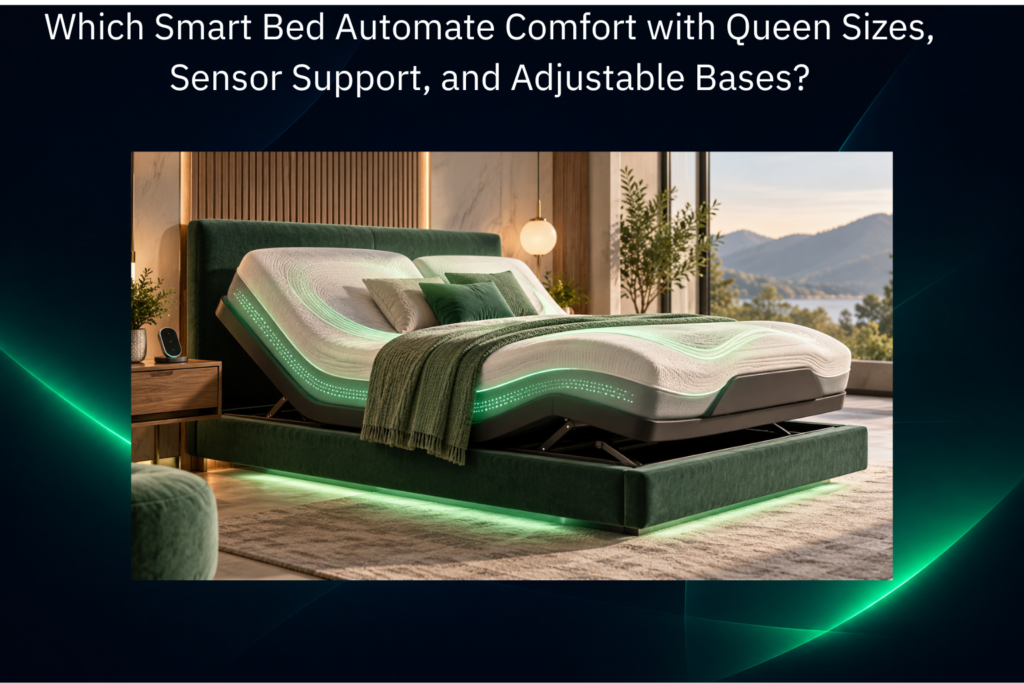
Which Smart Beds Offer Queen Sizes, Sensor Support, and Adjustable Bases?
Determining which smart beds offer queen sizes, sensor support, and adjustable bases requires understanding that these features may be supplied by separate components—a mattress, a sleep-monitoring system, and a motorized frame—or combined in one integrated product.
A queen-size smart mattress can track selected sleep-related signals without moving at all. An adjustable base can raise a mattress without measuring sleep, while a coordinated system may connect sensor readings to supported automatic adjustments. Before buying, identify exactly what is included, what works together, and which functions require an account, subscription, or additional accessory. This guide moves from smart-bed types to the measurements, compatibility checks, operating costs, and setup decisions that matter when selecting a complete system.
Why Smart Beds Can Improve Personalized Sleep Comfort
Smart beds can support personalized comfort through features such as adjustable positioning, variable firmness, and temperature control, depending on the technology included in the specific model. These functions address different preferences: a motorized frame changes position, an adjustable-air mattress changes its support setting, and a climate system changes the temperature of its supported components.
Rule: Judge a smart bed by the adjustment it actually performs, not by the word smart on the product description. Reason: A connected app may provide only reports, while another app controls the mattress or base. Example: A sleeper can select a comfortable head-elevation setting on a compatible base; a different system may allow that sleeper to change air-chamber firmness without moving the frame.
Some bases advertise a “zero-gravity” preset, but the position and control options differ between manufacturers. Comfort preferences also differ between sleepers. An elevation preset is not a medical treatment, and a consumer smart bed should not be assumed to relieve pain, acid reflux, or a sleep disorder merely because a product description mentions those conditions.
What Are the Main Types of Smart Beds?
Smart beds can be grouped into seven functional types according to their principal technologies, although individual products may combine features from several categories. These are useful shopping categories rather than exclusive standards: a bed with adjustable air chambers might also track sleep and offer temperature controls. A standalone sleep app, meanwhile, does not turn every mattress into an automated bed.
How Smart Adjustable Beds Customize Sleep Positioning
Smart adjustable beds use motorized frames to change supported sleeping positions, with control options that may include a remote, mobile application, or compatible voice interface. Common functions include raising the head or foot section and selecting stored positions; “zero-gravity” is a model-specific preset rather than one fixed universal angle. This category suits buyers who want positioning flexibility, but the selected mattress must tolerate the base’s movement and meet the manufacturer’s compatibility requirements.
How Sleep-Tracking Smart Beds Monitor Rest
Sleep-tracking smart beds use compatible sensing technologies to estimate sleep-related measurements, with the available metrics and sensor placement varying by product. Some systems estimate movement, heart rate, or breathing patterns using pressure sensors or motion-sensitive techniques such as ballistocardiography, which observes small body movements associated with cardiac activity.
They may suit people seeking hands-free wellness trends, but individual readings and sleep-stage estimates have limitations and should not be treated as clinical diagnoses. The American Academy of Sleep Medicine’s position statement on consumer sleep technology explains why consumer-generated sleep data should not replace appropriate clinical evaluation.
How Temperature-Regulating Smart Beds Control Climate
Temperature-regulating smart beds use model-specific heating or cooling systems to modify the sleeping environment, potentially including air circulation, water-based components, or controlled surface temperature. Certain configurations let partners choose different settings on their respective sides, while others operate as a single zone. Buyers who prefer a warmer or cooler bed should confirm available zone controls, maintenance requirements, operating noise, and whether the selected queen configuration supports those functions.
How Smart Air Beds Adapt Mattress Firmness
Smart air beds use adjustable air chambers to modify mattress support or firmness according to the controls and chamber configuration provided by the manufacturer. Increasing or decreasing chamber pressure can change the supported feel; models with separately controlled chambers may let partners select different settings. Check the pump, chamber arrangement, repair support, and compatible base requirements rather than assuming all air mattresses operate identically or last longer than other constructions.
How Anti-Snore Smart Beds Respond to Snoring
Anti-snore smart beds may use compatible sound or vibration sensing to detect patterns associated with snoring and trigger supported changes in bed position. On some models, a detected event can prompt a small head-section adjustment; on others, a preset requires manual selection. These features may interest couples affected by nighttime snoring, but detection can be affected by other sounds or movements, and positional responses do not diagnose or treat obstructive sleep apnea.
How AI-Powered Smart Beds Automate Comfort Settings
AI-powered smart beds may use data-processing software or machine-learning methods to recommend or automate supported comfort settings, depending on the manufacturer’s implementation. A system might use stored preferences, sensor input, or preset schedules to manage temperature, firmness, or position when that function is offered. Check the actual automation rules and whether they work locally, need Wi-Fi, or depend on a paid account; the label AI-powered alone does not demonstrate real-time adaptive performance.
How Integrated Smart Bed Systems Combine Core Technologies
Integrated smart bed systems combine selected mattress, sensing, control, and adjustment technologies into a coordinated product configuration designed to operate together. Buying a packaged system can simplify component selection, particularly when the manufacturer documents all supported parts, but this does not eliminate maintenance or future compatibility questions. Review whether individual components can be replaced, which functions require proprietary controllers, and whether the mattress, electronics, and base share the same warranty terms.
Smart Bed Types Comparison Matrix
| Smart Bed Type | Defining Technology | Primary Function | Best For | Key Limitation |
|---|---|---|---|---|
| Smart adjustable beds | Powered articulation and supported connected controls | Change available sleeping positions | Buyers who want adjustable positioning | Mattress and base compatibility |
| Sleep-tracking smart beds | Model-specific sleep-related sensors | Estimate supported sleep metrics | Users seeking hands-free wellness data | Accuracy and metric availability vary |
| Temperature-regulating smart beds | Heating or cooling components | Adjust supported climate settings | People seeking temperature personalization | Maintenance and zone options vary |
| Smart air beds | Adjustable air chambers | Modify firmness or support | People wanting variable firmness | Pumps and chambers require appropriate care |
| Anti-snore smart beds | Snore sensing and supported positioning | Trigger available positional responses | Users interested in automated snore responses | Detection and response effectiveness vary |
| AI-powered smart beds | Software analysis or automation | Recommend or adjust supported settings | Users seeking less manual adjustment | Automation and network requirements vary |
| Integrated smart bed systems | Coordinated mattress and connected components | Combine selected functions | Buyers wanting a packaged setup | Replacement and warranty terms vary |
How Queen Sizes, Sleep Sensors, and Adjustable Bases Work in Smart Beds
Queen smart bed compatibility depends on the dimensions of the mattress and frame, the type and placement of sleep sensors, and whether the adjustable base supports the selected mattress system. In U.S. sizing, a standard queen mattress is nominally 60 inches wide by 80 inches long, as described in Sleep Foundation’s queen-size dimension guide. Other regions and special configurations can differ.
The external frame can be larger than the mattress, so measure the complete footprint and the space occupied as the base articulates. A queen size label by itself cannot establish that the mattress is approved to bend on a particular base.
Sensors and positioning controls serve different functions. A sensor may record movement or estimate sleep metrics without changing anything physically. An automated model can instead use supported measurements or a saved rule to initiate an adjustment, but only if the relevant sensors, control software, and motors are designed to communicate. A remote-operated position change is not necessarily an automatic response to sleep data.
Climate systems are also optional, and estimated sleep stages should be treated as consumer wellness information rather than a sleep-study result. Before connecting a smart bed to an app, review what personal information is collected, whether it is stored locally or in the cloud, who receives it, and what export or deletion options are available. Some functions may operate offline; others can depend on subscriptions, cloud services, or internet access.
What Smart Bed Features Should You Compare Before Buying?
Smart bed features should be compared according to their actual functions, user controls, physical compatibility, maintenance requirements, and any additional costs. Build a feature list from the precise model you intend to buy, rather than treating an advertised feature as standard across a brand’s full catalog.
- Sleep tracking and sensor measurements: Note the metrics displayed, how they are estimated, and what data controls are available.
- Adjustable firmness and motorized positioning: Separate mattress firmness controls from movements performed by the base.
- Snore-response functions: Confirm the sensing trigger, supported positional response, and any user settings.
- Temperature control: Identify whether heating or cooling is offered, the technology involved, and available zones.
- Partner-specific controls: Verify which functions can be independently adjusted and whether a split mattress is required.
- App integration, subscriptions, and connectivity: Check phone support, offline behavior, service fees, and account requirements.
Feature Framework Table
| Feature | What It Does | Who Benefits | What to Verify |
|---|---|---|---|
| Sleep tracking | Estimates available sleep-related metrics | Users interested in wellness monitoring | Sensor type, metrics, limitations, privacy controls |
| Adjustable firmness and positioning | Changes supported firmness or bed position | Users who prefer adjustable comfort | Actual controls, adjustment range, compatibility |
| Snore response | May trigger a position change after snore detection | Users seeking automated positional responses | Detection method, available adjustments, limitations |
| Temperature control | Changes supported heating or cooling settings | Sleepers with different temperature preferences | Air or water system, zones, upkeep |
| Partner controls | Separates certain functions between sleepers | Couples wanting different settings | Split design, independent functions, shared limitations |
| Apps, subscriptions, connectivity | Enables supported controls, accounts, or data access | People who want connected features | Device support, fees, accounts, offline operation |
How to Compare Smart Bed Models by Automation, Sensors, and Comfort
Comparing smart bed models requires evaluating documented adjustment functions, available sensing capabilities, component compatibility, and the costs of purchasing and maintaining the complete system. A premium product may include a motorized base, while a similarly marketed product sells its base separately. Compare the contents of the offer, not just the advertised mattress price.
Product Comparison Matrix — buyer-fillable template
| Brand / Model | Queen Size | Sensor Functions | Automated Adjustments | Climate Features | Partner Controls | Subscription Fees | Warranty |
|---|---|---|---|---|---|---|---|
| Model being evaluated | Verify dimensions | Verify available metrics | Verify exact automatic functions | Verify availability | Verify configuration | Verify current terms | Verify component coverage |
Total Cost Evaluation
- Mattress and Base Price: Compare mattress and adjustable-base prices separately if each is sold as a distinct item.
- Sensor/Technology Package: Confirm whether sensing is included or requires an add-on.
- Delivery/Installation: Check shipping, assembly, removal, or in-home setup charges.
- App/Subscription Charges: Identify features available without payment and those tied to ongoing fees.
- Electricity Use: Review the manufacturer’s operating specifications instead of assuming all beds consume the same amount of power.
- Replacement Electronics/Service Costs: Check repairability, parts availability, geographic servicing, and coverage after the warranty ends.
Record exact warranty exclusions and trial conditions beside the model name. Without the manufacturer’s current product details, neither a lifetime ownership price nor a ranking of sensor accuracy can be stated reliably.
How to Check Smart Mattress and Adjustable Base Compatibility
Smart mattress and adjustable base compatibility depends on approved mattress construction, base dimensions, articulation limits, electrical requirements, and the placement of any integrated sensors or electronic components. Check both manufacturers’ instructions when purchasing separate components. An air-chamber mattress may need protection from pinched hoses, for example; Sleep Number’s base compatibility guidance illustrates why checking actual support and tubing requirements matters, rather than relying on matching size labels alone.
Before purchase, verify these points: mattress flexibility; manufacturer-approved base combinations; rated load limits; external frame dimensions; articulation clearance; power requirements; and the intended sensor position. For a connected system, also check which controller manages each function and whether another brand’s base can be paired at all.
Component Inspection Table
| Component | What to Check | Good Sign | Warning Sign |
|---|---|---|---|
| Mattress | Dimensions, flexibility, approved base use | Matches manufacturer requirements | Unsupported or incompatible configuration |
| Base | Size, rated capacity, articulation | Supports mattress and intended use | Mismatched size or prohibited operation |
| Motors | Clearance and movement range | Operates within documented limits | Obstruction or unusual operation |
| Sensors | Placement and compatibility | Installed as instructed | Unsupported or unstable placement |
| Wiring | Routes around moving parts | Secured and clear of pinch points | Pinched or damaged cables |
| Controls | Remote, app, supported functions | Commands operate as intended | Unresponsive or unexpected operation |
| Connections | Power, data, component connections | Correctly connected and supported | Loose, damaged, incompatible connections |
A visual check does not certify an electrical system or establish that an unapproved mattress is safe to articulate. If the bed behaves unexpectedly or a cable appears damaged, stop operating that function and contact the appropriate manufacturer or qualified service provider.
How to Choose a Smart Bed for Your Bedroom and Sleeping Needs
Choosing a smart bed requires matching its available comfort functions, complete external dimensions, and supported partner-control configuration with the bedroom and the sleepers’ preferences. A queen mattress may offer enough sleeping surface for a couple but still be incompatible with a particular headboard, platform, or under-bed furniture arrangement.
If: Two people need separate head or foot positions or different temperature settings. Do: Confirm that the manufacturer sells a compatible split or dual-zone version, and identify exactly which functions are independent. Result: You can determine whether the available configuration matches both sleepers’ preferences rather than assuming a standard, one-piece queen permits independent movement.
Measure the room’s width and length, then compare them with the external frame footprint—not just the nominal 60-by-80-inch mattress. Leave the clearance required for articulation, access, surrounding furniture, and operation of any wall-hugger mechanism. Check that the bed and its packaged components can pass through the delivery route, and confirm accessible electrical outlets without running cables through moving frame parts.
How to Set Up Smart Bed Sensors, Controls, and Adjustable Bases
Smart bed setup may involve assembling the approved bed components, connecting power, pairing available controls, and configuring sensors or user preferences according to the manufacturer’s instructions. The sequence below is a general planning guide; use the instructions for your specific system whenever they differ.
- Confirm installation and clearance requirements. Assemble the supported frame and mattress components, verify wall and headboard space, and remove obstructions from the movement area.
- Connect electrical power. Use the manufacturer’s stated supply and cable-routing instructions. Install a surge protector only if it is recommended or permitted for the product.
- Pair supported controls and applications. Follow the documented remote, Bluetooth, Wi-Fi, or app steps. Create a cloud account only if required for the functions you want.
- Configure sensors and user profiles. Set up each supported sensing function and separate sleeper profiles, if available; perform calibration only where specified.
- Set comfort preferences. Save the supported positioning, firmness, or climate choices without assuming all functions are installed.
- Verify operation. With the mechanism clear of people, pets, objects, and cables, test the permitted functions according to the manufacturer. Confirm whether claimed automation actually operates automatically or requires a user command.
Do not force a stalled base or bypass a safety lockout. Mechanical, electrical, or overheating faults require the manufacturer’s service procedure rather than an improvised repair.
What Smart Bed Buying and Setup Mistakes Should You Avoid?
Smart bed purchasing and setup errors can result from assuming that components are universally compatible, misunderstanding which adjustments are automatic, or overlooking product-specific electrical and connectivity requirements. Separate the shopping mistake from the practical correction before investing in a complete system.
Good vs. Bad Examples
Bad: Buying a smart mattress without checking whether it works safely with an existing adjustable base.
Good: Verifying the mattress and base combination with the manufacturers before ordering.
Bad: Assuming a standard queen smart bed allows each partner to raise their side independently.
Good: Checking which split-queen or dual-zone configurations are offered and which functions actually operate separately.
Troubleshooting Checks
- App pairing fails: Confirm device and operating-system support, Bluetooth permissions, and the documented pairing method.
- Wi-Fi does not connect: Check supported network bands, account requirements, and whether the feature needs internet access.
- Sensor readings seem wrong: Verify placement and follow the manufacturer’s recalibration instructions, if offered.
- Motor or remote does not respond: Review approved pairing procedures, power status, and any displayed fault messages; do not force movement.
- Automatic changes do not occur: Confirm the function is included, enabled, and supported by the selected sensors or preset.
- Power is interrupted: Follow the documented outage procedure. Do not assume a backup battery is included.
- Firmware compatibility causes an error: Use only official update and recovery procedures.
- A feature is locked: Check whether it depends on a subscription, account type, or optional package.
Safety warning: Do not attempt unauthorized repairs to smart bed motors, electrical components, actuators, sensors, or control systems. Contact qualified service personnel for suspected mechanical or electrical defects.
Warranty fix: Compare mattress, frame, motor, electronics, labor, and replacement-parts coverage individually. Confirm who provides service in your area, whether shipping is included, and which trial exclusions, return charges, and restocking policies apply. A single branded system does not necessarily mean every component carries an identical warranty.
How to Verify Your Smart Bed Choice Before Buying
Before completing a smart bed purchase, verify the system’s dimensions, component compatibility, available technology, privacy requirements, and total ownership conditions against your individual needs. Check each item using the exact product specifications and purchase terms, not a general smart-bed category description.
- Queen Dimensions: Confirm the mattress’s actual measurements and the full external footprint of the frame.
- Mattress and Base Compatibility: Verify the approved component combination and supported articulation.
- Sleep Sensor Functions: Check that available wellness metrics match your expectations.
- Automatic Adjustments: Confirm what operates automatically versus what requires an app or remote command.
- Independent Partner Controls: Verify the supported split or dual-zone configuration if needed.
- Climate Control: Confirm the available heating or cooling functions and zones.
- App Compatibility: Check phone, operating-system, and connectivity requirements.
- Subscriptions and Costs: Review purchase, installation, ongoing service, and maintenance costs.
- Privacy and Personal Data: Review collection, sharing, export, and deletion options.
- Power and Connectivity: Confirm outlet access, voltage requirements, and any required network connection.
- Installation and Delivery: Check room clearance, articulation space, and delivery-route dimensions.
- Returns and Trials: Review return fees, trial conditions, and exclusions.
- Warranty Coverage: Compare mattress, frame, motor, and electronics coverage, including service limits.
Conclusion
A smart bed is best evaluated as a combination of distinct components rather than a single set of promised features. Queen-size dimensions establish the mattress’s nominal footprint, while sensor functions, automated comfort settings, and motorized positioning depend on the particular mattress, base, and control system.
Before choosing a model, confirm what the product actually includes, whether its components are approved to work together, and how it fits your room and sleeping preferences. Check privacy settings, operating requirements, subscriptions, service coverage, and warranty terms against the manufacturer’s documentation before purchasing.
References
- American Academy of Sleep Medicine — Consumer Sleep Technology: An American Academy of Sleep Medicine Position Statement. Background on the limits of consumer sleep data and its use in clinical care.
- Sleep Foundation — Queen-Size Bed Dimensions. Reference for nominal U.S. queen mattress measurements.
- Sleep Number — Do I Have to Use a Sleep Number Base With My Mattress?. Manufacturer information on mattress and base compatibility.

Mohamed Abdirahman Camay is the founder and lead content specialist at BedLuFix. He researches bed types, bed frames, mattress compatibility, sleep comfort, support systems, bedroom layouts, and key bed-buying factors. His research process includes reviewing manufacturer specifications, comparing product features and materials, and analyzing common consumer questions. He also develops practical bed calculators, comparison tools, checklists, and templates that simplify bed selection and bedroom planning. Mohamed creates clear guides and useful resources to help readers choose beds that suit their sleep needs, room size, lifestyle, and budget.