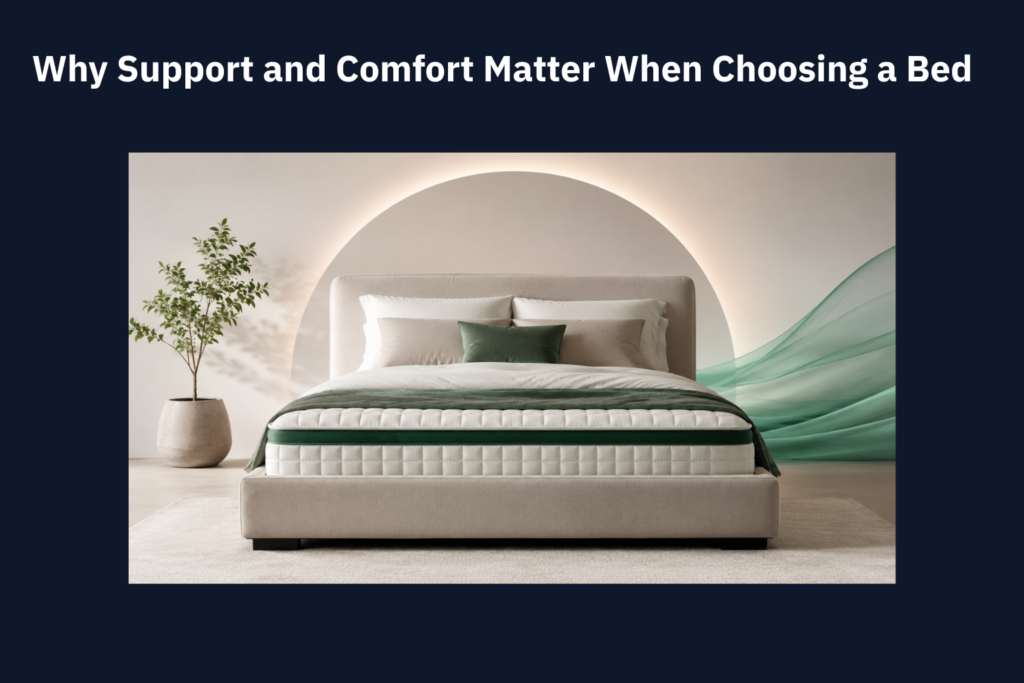
Why Support and Comfort Matter When Choosing a Bed
Choosing a bed requires evaluating two distinct but equally important ergonomic factors: the core’s ability to provide structural support for spinal alignment, and the top layers’ ability to deliver pressure-relieving comfort.
Prioritizing aesthetics or price over these factors often leads to poor fit, restless sleep, and morning discomfort. Support and comfort are factors to consider before buying a bed because they control spinal alignment, pressure relief, and long-term sleep comfort. This guide breaks down the critical difference between support and comfort, providing you with actionable frameworks to match a bed to your sleep position, body weight, and ergonomic needs. Think of a mattress like a house: support is the foundation that keeps the structure level, while comfort is the surface flooring that makes walking pleasant.
Why Support and Comfort Matter for Sleep Quality
Proper mattress support and comfort directly dictate physical recovery by reducing pressure buildup that may contribute to discomfort and enabling restorative sleep, making them the most critical deciding factors over brand name or aesthetic design. When a mattress properly balances a firm core with soft top layers, the body enters a state of relaxation faster. Neutral spinal alignment occurs when the spine maintains its natural curvature without twisting or bowing downward. A mattress that maintains this alignment reduces the risk of waking up with morning back pain or shoulder pressure. Buyers often fear investing in a mattress only to experience poor sleep, but focusing on ergonomic support mitigates that risk.
- Enables better sleep comfort and deeper sleep cycles.
- Reduces pressure points that cause numbness.
- Reduces tossing and turning by stabilizing the body.
- Maintains proper spinal alignment to reduce the risk of morning back discomfort.
Now that we understand how support impacts sleep quality, let’s clarify the physical differences between support and comfort.
*Source Note: Sleep Foundation, 2024.*
What Is the Difference Between Mattress Support and Pressure-Relieving Comfort?
The “Mattress Anatomy” Layer Diagram
The difference between mattress support and comfort lies in their anatomical functions: support maintains neutral spinal alignment via the bed’s core, while comfort provides surface cushioning to relieve pressure points at the hips and shoulders. The support core is the deep structural layer—usually composed of dense foams, latex, or steel coils—that provides push-back against body weight. Without a functional support core, the mattress will sag, compromising spinal integrity regardless of the top layer’s plushness.
- Support = How well the bed keeps your spine in neutral alignment (push-back).
- Comfort = How well the top layers relieve pressure points at the hips and shoulders (cushioning).
A mattress can be incredibly firm but completely lack support, or extremely soft but entirely lack comfort. Support originates from the deep core, which prevents the heavy parts of the body from sinking too far. Comfort originates from the top layers, which conform to the body’s curves. For example, a sagging old innerspring mattress topped with a brand-new memory foam topper will feel “comfortable” on the surface, but it fundamentally lacks “support” because the core is compromised.
Once you recognize the mechanical difference between support and comfort, you can begin matching these factors to your specific sleep position.
*Source Note: Better Sleep Council, 2024.*
How to Match Support and Comfort to Your Sleep Position
The “Neutral Spinal Alignment” Silhouette
Matching support and comfort to your sleep position requires analyzing how your body interacts with the mattress surface to maintain structural alignment without creating joint friction. Sleeping position should guide support and comfort because side, back, stomach, and combo sleepers need different firmness levels. Pressure relief refers to the mattress’s ability to distribute body weight evenly, reducing localized stress on heavier or protruding areas like the hips and shoulders.
| Sleep Position | Ideal Comfort Level | Why it works |
|---|---|---|
| Side | Soft to Medium | Allows shoulders and hips to sink in and relieve pressure. |
| Back | Medium-Firm | Cushions the lumbar region while preventing the torso from bowing down. |
| Stomach | Firm | Prevents the hips from sinking deeply, which protects the lower back. |
| Combo | Responsive Medium | Balances cushioning with the bounce needed to change positions easily. |
*Source Note: Sleep Foundation, 2024.*
Side Sleepers
Side sleepers require significant cushioning in the comfort layer to accommodate the sharper angles of the shoulders and hips. A softer mattress surface allows these areas to sink just enough to prevent pressure buildup and numbness. However, the support core must still provide enough push-back to keep the spine horizontally straight.
Back and Stomach Sleepers
Back sleepers benefit most from medium-firm surfaces that fill the gap beneath the lower back without allowing the hips to sink excessively. Stomach sleepers need even firmer surfaces; a soft mattress causes their midsection to bow downward, straining the lower back out of neutral alignment.
Combo Sleepers
Combo sleepers move frequently throughout the night, requiring materials that respond quickly to weight changes. A responsive medium-firm surface provides balanced cushioning while preventing the sleeper from feeling stuck when shifting from their back to their side.
While sleep position dictates your baseline firmness need, your body weight drastically alters how that firmness actually feels.
How Body Weight Affects Bed Support and Comfort Needs
The “Weight vs. Sinkage” Scale
Rests mostly on top. Needs softer comfort layers to contour.
Balanced sink. Engages both comfort and upper support layers.
Deep sinkage. Requires firm core push-back to prevent sagging.
Body weight significantly alters how a mattress performs, determining the level of core push-back and surface density required to achieve the intended balance of support and comfort. A body weight range categorizes sleepers to help predict how deeply they will compress the comfort layers and engage the support core. Buyers frequently fear a sagging mattress or sinking too deeply, which usually stems from choosing a support core inadequate for their specific weight.
| Body Type | Support Need | Comfort Need | Best Firmness Range | What to Avoid |
|---|---|---|---|---|
| Lighter (< 130 lbs) | Minimal push-back | Plush contouring | Soft to Medium-Soft | Ultra-firm cores that cause joint pressure. |
| Average (130-230 lbs) | Standard push-back | Balanced contouring | Medium to Medium-Firm | Extremes on either end of the firmness scale. |
| Heavier (> 230 lbs) | Heavy-duty push-back | Dense, durable cushioning | Firm to Extra-Firm | Soft foams that bottom out or lack edge support. |
*Source Note: Sleep Foundation Firmness Guide, 2024.*
Understanding your weight profile allows you to select the appropriate mattress materials to deliver that precise level of support.
How Mattress Materials Affect Bed Support, Comfort, and Pressure Relief
Material Performance Radar
Memory Foam
Latex
Innerspring
Hybrid
Mattress materials fundamentally alter the delivery of support and comfort, with memory foam, latex, innersprings, and hybrids offering distinct performance profiles regarding push-back, cushioning, and durability. Mattress type affects support and comfort because foam, latex, innerspring, and hybrid designs respond differently to body weight and pressure points. Breathability and temperature control also affect comfort because heat retention can disrupt restorative sleep. Firmness describes the initial feel or resistance of the mattress surface, ranging from soft to extra-firm.
- Memory Foam: Delivers superior pressure relief by contouring closely to the body, but lower foam density can compromise long-term support.
- Latex: Provides responsive support and durability, naturally resisting sagging while offering buoyant comfort that prevents excessive sinking.
- Innerspring: Maintains strong structural support and breathability, though traditional designs often lack adequate pressure relief without a thick comfort layer.
- Hybrid: Combines pocketed coils for targeted support with foam or latex top layers for cushioning.
If you sleep hot and require heavy support, you should choose a hybrid mattress; this results in better airflow and stronger coil push-back compared to all-foam beds.
*Source Note: Better Sleep Council, 2024.*
Knowing which materials suit your profile is only half the battle; you must physically test them to ensure they perform correctly.
How to Test Bed Support and Comfort Before Buying
The 10-Minute Showroom Test Timeline
Position
Lie down in your normal sleeping posture.
Align
Check if your spine feels horizontally straight.
Wait 10 Mins
Let muscles relax and foams fully compress.
Lumbar Check
Roll to your back. Ensure no gaps under lower back.
Testing bed support and comfort requires a systematic approach to evaluating spinal alignment, pressure relief, and lower-back stability during a showroom visit or an at-home sleep trial. A sleep trial is a designated period provided by the manufacturer allowing the buyer to test the mattress at home and return it if it fails to provide adequate comfort or support. Rushing a showroom test often results in selecting a bed that feels plush initially but lacks the push-back necessary for eight hours of sleep.
| Test | What to Check | Good Sign | Warning Sign |
|---|---|---|---|
| Spinal alignment test | Lie in your normal position | Spine stays neutral (straight line) | Hips sink deeply or shoulders lift up. |
| Pressure relief test | Stay entirely still for 10 minutes | Reduced noticeable pressure on hips or shoulders | Numbness, tingling, or sharp localized pressure. |
| Lower-back support test | Lie flat on your back | Lower back feels completely supported | A physical gap or sagging feeling under the lumbar spine. |
*Source Note: Sleep Foundation Mattress Buying Guide, 2024.*
Even with thorough testing, many buyers still fall prey to common support and comfort mistakes.
What Support and Comfort Mistakes Should You Avoid When Buying a Bed?
Buyers routinely compromise their sleep by committing common support and comfort mistakes, often judging a mattress by a brief, superficial showroom feel rather than its structural alignment. Lower-back support involves the mattress contouring to the lumbar region, preventing the muscles from straining to bridge a gap between the body and the bed. The fear of a wasted purchase and return hassle is entirely valid when buyers prioritize aesthetics over biomechanics.
-
Bad: Choosing the softest mattress because it feels comfortable for 2 minutes.
-
Good: Choosing a mattress that cushions the shoulders and hips while keeping the spine aligned for 8 hours.
-
Bad: Choosing an ultra-firm bed strictly because you have back pain.
-
Good: Choosing firmness based on a holistic view of your sleep position, body weight, and specific support needs.
-
Mistake: Ignoring body weight (heavier sleepers require denser support cores to achieve the exact same comfort level as lighter sleepers on softer beds).
*Source Note: Spine-Health Guidelines, 2024.*
To avoid these pitfalls, use a structured evaluation before making your final purchase.
How to Finalize Your Support and Comfort Decision Before Buying
To finalize your support and comfort decision, use a structured evaluation checklist to verify the mattress meets your specific ergonomic and biomechanical requirements before purchasing. Push-back refers to the resistance the support core provides against the sleeper’s body weight, which maintains surface stability and spinal alignment. A structured approach removes the guesswork from mattress shopping.
Final Decision Checklist
*Source Note: Better Sleep Council Buying Guide, 2024.*
By following this checklist, you can confidently review the core attributes of any mattress.
Support and Comfort Attribute Table
The following table summarizes the core attributes of mattress support and comfort, providing a rapid reference guide for evaluating firmness, body weight needs, and material behavior.
| Attribute | Value or Explanation |
|---|---|
| Support | Keeps the spine in neutral alignment. |
| Comfort | Cushions pressure points at the hips, shoulders, and joints. |
| Support core | The deeper mattress layer that creates push-back and stability. |
| Comfort layer | The top mattress layer that controls cushioning and pressure relief. |
| Side sleeper need | Softer comfort with enough support to keep the spine straight. |
| Back sleeper need | Medium-firm support with lumbar stability. |
| Stomach sleeper need | Firmer support to prevent hip sinking. |
| Heavier sleeper need | Denser support core and durable comfort materials. |
| Testing rule | Test the mattress in your normal sleep position before buying. |
*Source Note: Sleep Foundation Mattress Information, 2024.*
With these attributes defined, we can consolidate the evaluation process into a final buying decision.
Conclusion
Support and comfort should be evaluated before mattress type, brand, or price because these two factors control spinal alignment, pressure relief, and long-term sleep comfort. By matching your primary sleep position to the necessary comfort level and adjusting for your specific body weight, you ensure the support core provides adequate push-back. Understanding how materials like memory foam, latex, and hybrid designs perform allows you to select the right combination for durability and pressure relief. Testing these factors methodically prevents common buying mistakes that lead to discomfort. At Bedlufix, we recommend choosing a bed by testing support and comfort first because the right mattress must keep your body aligned while relieving pressure. A good bed decision becomes easier when you know how support and comfort should feel in your own body.
Quick Answers About Support and Comfort Before Buying a Bed
To provide immediate clarity, this section answers the most common questions regarding mattress support and comfort before making a purchase.
What is the difference between support and comfort?
Support keeps the spine aligned through the structural push-back of the mattress core. Comfort cushions pressure points at the hips and shoulders through the softer top layers. Both factors require evaluation to ensure restorative sleep.
*Source Note: Better Sleep Council, 2024.*
Is a firm mattress always more supportive?
Firmness and support are not the same metric. A firm mattress can still lack proper support if the inner core sags or fails to stabilize the lower back during sleep. Support relies on structural integrity, not just surface feel.
*Source Note: Sleep Foundation, 2024.*
What comfort level is best for side sleepers?
Side sleepers usually need soft to medium comfort layers because the shoulders and hips require pressure relief. The mattress surface must conform to these sharper angles to prevent numbness while the core maintains neutral alignment.
*Source Note: Sleep Foundation, 2024.*
What support level is best for back sleepers?
Back sleepers usually need medium-firm support because the mattress must stabilize the lumbar area without creating pressure. A proper support core prevents the heavier torso from sinking down and bowing the spine out of alignment.
*Source Note: Sleep Foundation, 2024.*
How do I test mattress support before buying?
Users should lie in their normal sleep position for at least 10 minutes. Check whether the spine stays neutral, the hips avoid excessive sinking, and the lower back feels completely supported without gaps.
*Source Note: Sleep Foundation Mattress Buying Guide, 2024.*

Mohamed Abdirahman Camay is the founder and lead content specialist at BedLuFix. He researches bed types, bed frames, mattress compatibility, sleep comfort, support systems, bedroom layouts, and key bed-buying factors. His research process includes reviewing manufacturer specifications, comparing product features and materials, and analyzing common consumer questions. He also develops practical bed calculators, comparison tools, checklists, and templates that simplify bed selection and bedroom planning. Mohamed creates clear guides and useful resources to help readers choose beds that suit their sleep needs, room size, lifestyle, and budget.