The S5 Protocol: A Diagnostic Framework for Resolving Midnight Thermoregulation Failure
A comprehensive resolution of “midnight thermoregulation failure” requires analyzing two distinct pillars: the isolation of environmental variables through a data-driven protocol and the validation of a permanent solution through rigorous A/B testing.
This framework transitionally reclassifies the “hot sleeper” from a subjective identity to a quantifiable diagnostic subject. By applying the S5 Protocol, individuals can identify the specific thermal bottlenecks preventing necessary physiological cooling during the circadian nadir.
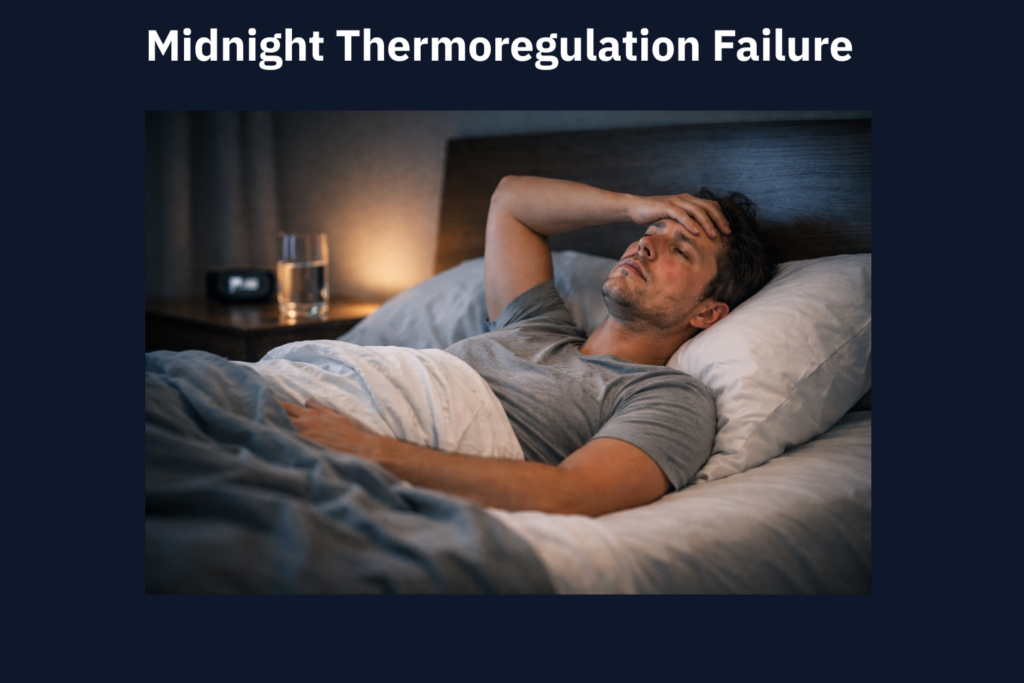
Why Midnight Thermoregulation Failure Causes Chronic Sleep Cycle Disruptions
“Midnight thermoregulation failure” triggers cortical arousal when the sleep environment prevents the natural \(1^{\circ}\text{C}\) to \(1.3^{\circ}\text{C}\) core temperature drop required to maintain deep NREM and REM sleep stages. This failure occurs when the heat dissipation mechanisms of the body—primarily vasodilation in the distal skin—are countered by an insulating microclimate that exceeds the body’s ability to shed thermal energy.
The “Thermal Nadir” occurs between 1 AM and 4 AM, a window where the human metabolic rate drops to approximately \(0.7\text{ met}\). During this period, the brain requires the lowest core body temperature (CBT) of the 24-hour cycle to consolidate sleep. If the microclimate temperature within the bedding reaches or exceeds the threshold of \(34^{\circ}\text{C}\), the hypothalamus triggers an arousal response to initiate behavioral thermoregulation (e.g., shedding covers), effectively fragmenting the sleep architecture.
Fig 1.1: Circadian Thermal Nadir & Arousal Threshold
| Parameter | Metric Value / Timing | Physiological Significance |
|---|---|---|
| CBT Peak | ~9 PM – 10 PM | Maximum metabolic heat before sleep onset |
| CBT Nadir Timing | 3 AM – 5 AM | Minimum temperature required for REM stability |
| Metabolic Rate | \(0.7\text{ met}\) | Reduced heat production during deep sleep |
| Awakening Threshold | \(>34^{\circ}\text{C}\) | Temperature at which cortical arousal occurs |
How the S5 Protocol Isolates Variables Affecting Midnight Thermoregulation Failure
The S5 Protocol isolates the primary drivers of “midnight thermoregulation failure” by separating the sleep environment into two independent variables: Bedding Material (Variable A) and Ambient Temperature (Variable B). Resolving chronic awakenings requires determining whether the failure is “insulation-driven” or “resistance-driven.”
Variable A focuses on the Material Property Matrix. Synthetic fibers, such as polyester, possess high thermal resistance and low hygroscopicity, meaning they trap heat while failing to manage the \(25\text{ml}\) to \(50\text{ml}\) of insensible perspiration produced per hour. In contrast, natural nanofibril structures like Tencel or high-gauge linen facilitate capillary action, moving moisture away from the skin to allow for evaporative cooling.
Variable B addresses Ambient Temperature. The physiological threshold for effective core temperature shedding is widely established at \(18.3^{\circ}\text{C}\) (\(65^{\circ}\text{F}\)). If the ambient room temperature exceeds this limit, the temperature gradient between the skin and the air is insufficient to drive heat away from the body, regardless of the bedding material used.
Fig 2.1: Material Property Matrix Performance
| Material Type | Thermal Resistance (\(R_{ct}\)) | Hygroscopicity (Moisture Absorption) |
|---|---|---|
| Polyester | High | \(<1\%\) (Hydrophobic) |
| Cotton/Linen | Moderate | \(8\% – 12\%\) |
| Tencel | Low | \(13\% – 15\%\) (Optimal) |
When to Implement Controls for Midnight Thermoregulation Failure During the Testing Phase
Implementing strict environmental controls before the testing phase eliminates confounding variables that mimic “midnight thermoregulation failure” and skew diagnostic data. Without these controls, metabolic spikes or delayed heat dissipation can be misidentified as environmental failures.
The 90-Minute Hydrotherapy Rule utilizes Passive Body Heating (PBH) to induce rapid vasodilation. A warm shower or bath (\(40^{\circ}\text{C} – 42^{\circ}\text{C}\)) must be completed exactly 90 minutes before sleep; this timing allows the subsequent “rebound” cooling to align with sleep onset. Showers taken within 60 minutes of sleep should be avoided, as they can leave residual skin humidity that interferes with the microclimate.
Dietary restrictions are equally vital. Capsaicin interacts with POA (Preoptic Area) warm sensors, potentially causing a delayed sweating response that disrupts the 3 AM window. Similarly, alcohol must be eliminated during testing; while it initially aids sleep onset, the subsequent metabolic “rebound effect” increases heart rate and heat production precisely when the body should be reaching its \(0.7\text{ met}\) nadir.
Fig 3.1: Hydrotherapy Cooling Response
How to Utilize the S5 Protocol Data Collection Log to Track Midnight Thermoregulation Failure
Tracking “midnight thermoregulation failure” requires a 7-day quantitative logging period to move the user from anecdotal observation to empirical evidence. Subjective feelings of “feeling hot” are replaced with a standardized Thermal Comfort Scale and environmental metrics.
The Thermal Comfort Scale is defined on a 1–10 gradient: 1–3 indicates shivering or thermal insufficiency; 5 represents “Thermal Neutrality” (the target); and 8–10 indicates active diaphoresis (sweating). By logging the exact time of awakenings alongside the room temperature, the user can map the failure point against the circadian clock.
| Night | Room Temp (\(^{\circ}\text{C}\)) | Waking Frequency | Comfort Score (1-10) |
|---|---|---|---|
| 1 | |||
| 2 | |||
| 3 | |||
| 4 | |||
| 5 | |||
| 6 | |||
| 7 |
Live Diagnostic Dashboard
Analyzing Quantitative Results to Diagnose the Cause of Midnight Thermoregulation Failure
Analyzing the collected data involves segmenting waking frequency by variable to identify the “primary thermal driver” causing the 1 AM – 4 AM disruptions. The goal is to distinguish between “Ambient Sensitivity” (the room is too warm) and “The Material Trap” (the bedding is too insulating).
If awakenings occur regardless of room temperature fluctuations, the diagnosis is likely “The Material Trap.” This suggests that the thermal resistance of the mattress or duvet is too high, creating a localized heat pocket. If awakenings only occur when the room exceeds \(19^{\circ}\text{C}\), the diagnosis is “Ambient Sensitivity,” indicating the body requires a steeper temperature gradient to reach the nadir.
Fig 5.1: Diagnostic Scatter Plot Patterns
Diagnostic Template:
“The data indicates that awakenings occur at 1 AM – 4 AM when room temperature is [Y]\(^{\circ}\text{C}\). Because comfort score is [Z], the primary driver is [Ambient/Material].”
Enter your 7-day log data above to populate this automated analysis.
How to Validate the Midnight Thermoregulation Failure Hypothesis with A/B Testing
Validating the cause of “midnight thermoregulation failure” requires a second 7-day confirmation experiment focusing on the “winning” variables identified in the initial log. This phase confirms that the identified solution is repeatable and not a result of sleep debt or random variance.
During this phase, implement one primary change (e.g., switching to Tencel sheets or dropping the thermostat to \(17.5^{\circ}\text{C}\)). Long-term calibration must also account for seasonal radiant temperature changes. A room that is \(18.3^{\circ}\text{C}\) in winter may feel different in summer due to the “Radiant Temperature” of the walls; therefore, the S5 Protocol should be revisited quarterly to maintain environmental optimization.
Frequently Asked Scientific Questions
Does mattress type matter?
Yes. Hybrid mattresses combine foam with steel coils to create natural airflow channels that pull warm air away, averaging cooling scores of 8.8 compared to 8.2 for all-foam.
What if both variables fail?
Relative humidity \(>60\%\) prevents evaporative cooling, even at \(18^{\circ}\text{C}\); a dehumidifier is often the required “third variable” to break this thermal bottleneck.
Can I test both variables simultaneously?
No. The S5 Protocol strictly forbids simultaneous testing because it prevents variable isolation.
Conclusion: Achieving Long-Term Resolution of Midnight Thermoregulation Failure
In conclusion, “midnight thermoregulation failure” is not an inescapable biological condition but a diagnosable environmental failure that can be resolved through systematic variable isolation. Moving from a mindset of “I am a hot sleeper” to “my microclimate is thermally resistant” allows for a logic-based solution to chronic sleep fragmentation.
Fig 8.1: Expected Success Projection
Final Task Checklist

Mohamed Abdirahman Camay is the founder and lead content specialist at BedLuFix. He researches bed types, bed frames, mattress compatibility, sleep comfort, support systems, bedroom layouts, and key bed-buying factors. His research process includes reviewing manufacturer specifications, comparing product features and materials, and analyzing common consumer questions. He also develops practical bed calculators, comparison tools, checklists, and templates that simplify bed selection and bedroom planning. Mohamed creates clear guides and useful resources to help readers choose beds that suit their sleep needs, room size, lifestyle, and budget.