The Sleep Sanctuary Build-Out: The P5 Protocol for a High-Efficiency Recovery Chamber
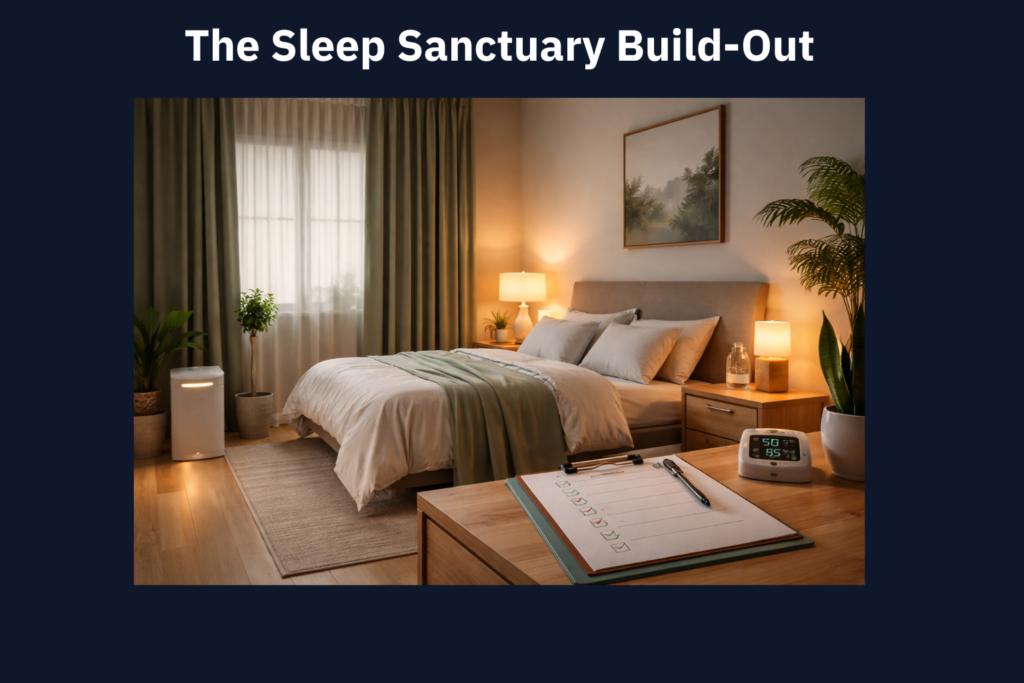
Achieving 85%+ sleep efficiency requires a “Sleep Sanctuary Build-Out” that transforms the bedroom from a multi-purpose living space into a single-purpose recovery chamber designed for total environmental control.
This engineering process prioritizes the biological requirements of the human body over aesthetic design choices. To quantify success, we use the clinical Sleep Efficiency (SE) formula:
Where $TST$ is Total Sleep Time and $DSE$ is the total Duration in the Sleep Environment.
The Definition of Done
The P5 Protocol establishes a “Definition of Done” based on four measurable milestones: 0.0 lux of ambient light, ambient noise levels below 30 Decibels (dB), a minimum of 4.8 Air Changes per Hour (ACH), and a surface temperature standardized at $18^\circ C$.
Why The Sleep Sanctuary Build-Out is Essential for Physical Recovery
The Sleep Sanctuary Build-Out is essential because physical recovery depends on the elimination of cognitive and environmental friction, allowing the brain to associate the bedroom exclusively with sleep. Environmental optimization directly influences the endocrine system, specifically the production of melatonin.
The Sleep Sanctuary Build-Out optimizes melatonin secretion by protecting Melanopsin-containing Retinal Ganglion Cells from exogenous light. Clinical sleep science confirms that melatonin suppression occurs at 10 LUX; therefore, the recovery chamber must eliminate all short-wavelength blue light to prevent Circadian Biology disruption. Implementing Sleep Restriction Therapy (SRT) within a standardized environment ensures the 85% SE benchmark remains the primary performance metric. Darkness triggers the parasympathetic nervous system, initiating the biological recovery sequence required for cellular repair.
Fig 1: Melatonin Suppression vs. Light Intensity
Perform an Environmental Audit for The Sleep Sanctuary Build-Out
Before the build-out begins, an Environmental Audit identifies specific light leaks, thermal fluctuations, and audio disruptions that compromise recovery. This diagnostic phase ensures that hardware investments target the actual points of failure in the current room configuration.
Standard curtains frequently fail the light leak audit due to gaps at the top, sides, bottom, and center seam, which permit “light pollution” to enter the chamber. Furthermore, ambient noise must remain below 30 dB(A) to prevent micro-arousals during the transition from N2 to N3 (Deep) sleep. Thermal logs often reveal that the room temperature rises significantly between 10 PM and 4 AM, which prevents the core body temperature drop necessary for sleep maintenance.
The 3-Point Build-Out Audit
| Audit Type | Action | Metric/Goal |
|---|---|---|
| Light Leak | Night-time blackout test with all lights off. | 0 LUX (Total Darkness) |
| Thermal Log | Record temperature at 10 PM and 4 AM. | $18^\circ C$ Surface Temp |
| Audio Scan | Use a decibel meter to identify peak noise. | Identify spikes > 35 dB |
Source the Core Assets for Your Sleep Sanctuary Build-Out
Sourcing core assets for the Sleep Sanctuary Build-Out involves selecting hardware based on functional performance rather than aesthetic appeal. Hardware must meet specific certifications to ensure that the atmospheric and physical pillars of the P5 Protocol are satisfied.
Choose the Foundation for Your Sleep Sanctuary Build-Out
The bed frame provides a noise-free, 100% flat support to maintain spinal alignment. When sourcing mattresses and pillows, prioritize materials with GREENGUARD Gold or CertiPUR-US certifications. These certifications are necessary to mitigate the off-gassing of Volatile Organic Compounds (VOCs), which can irritate the respiratory system and increase sleep onset latency (SOL).
Select Light-Blocking and Airflow Solutions for the Build-Out
The Sleep Sanctuary Build-Out requires sealed track technology, such as UBlockout, to eliminate the 15–40 lux leakage characteristic of standard shades. For atmospheric purification, calculate the required Clean Air Delivery Rate (CADR) using the AHAM standard formula:
Fig 2: Particulate (PM2.5) Decay Timeline
A high CADR ensures the air purifier effectively removes particulate matter, supporting consistent biological recovery.
How to Execute The Sleep Sanctuary Build-Out Setup and Calibration
Executing the build-out requires the physical installation of environmental controls and the precise calibration of the sleeping surface to ensure spinal alignment. Accurate calibration prevents physical pain from becoming a predisposing factor for wake after sleep onset (WASO).
To verify spinal neutrality, use the Side Profile Photo Test. A plumb line must pass through the earlobe, shoulder, and hip while the individual is in their primary sleeping position. If the plumb line deviates, the thermal mass and firmness of the mattress must be adjusted. Thermal resistance must also be calibrated using the Thermal Overall Grade (TOG) Rating: use 2.5–4.5 TOG for summer conditions and 12.0–15.0 TOG for winter to maintain the $18^\circ C$ target. For internal LED light pollution, use black electrical tape to cover all standby lights on smoke detectors or air purifiers.
Fig 3: The Thermal Optimum Matrix
Deploy the 7-Night “Burn-In” Phase for The Sleep Sanctuary Build-Out
The 7-night “Burn-In” phase tests the integrity of the build-out through data tracking and the elimination of all electronic variables. This phase transitions the environment from a physical project to a behavioral execution.
The P5 Protocol enforces the “15-Minute Get-Up” rule: if sleep onset does not occur within 15 minutes, the individual must exit the recovery chamber to maintain the stimulus control association. Research regarding Intensive Sleep Re-training (ISR) indicates that rapid conditioning is possible when the environment is standardized. During this phase, calculate WASO daily to identify remaining environmental triggers that require remediation.
Avoid Scope Creep During The Sleep Sanctuary Build-Out
Scope creep occurs when non-essential items like desks, televisions, or reading chairs are re-introduced into the recovery chamber, undermining the single-purpose engineering. The introduction of electronics triggers cognitive alertness and disrupts the psychological association between the room and rest.
Adhere to strict stimulus control: the bed is exclusively for sleep and intimacy. Removing all work-related hardware prevents the brain from entering a state of high-beta wave activity. The Sleep Sanctuary Build-Out must remain a dedicated zone for biological recovery to maximize long-term Sleep Efficiency.
Reviewing Your Sleep Sanctuary Build-Out Performance (Post-Mortem)
Reviewing build-out performance involves a weekly post-mortem to calibrate environmental variables based on subjective recovery and objective sleep data. This feedback loop identifies whether disruptions are Predisposing (long-term traits), Precipitating (immediate triggers), or Perpetuating (learned behaviors).
Fig 4: High-Efficiency Hypnogram Optimization
The P5 Build-Out Feedback Loop
| What Went Well? (Keep) | What Went Wrong? (Change) | Next Steps/Optimizations |
|---|---|---|
| Zero light intrusion confirmed. | Temp rose to $21^\circ C$ at 2 AM. | Lower AC or reduce TOG rating. |
| Noise remained < 30 dB. | SOL exceeded 30 minutes. | Re-apply 15-Minute Get-Up rule. |
Final Checklist: Is Your Sleep Sanctuary Build-Out Ready?
Starting Line: Use this final verification checklist to ensure your build-out meets the medical-grade standards of a high-efficiency recovery chamber.
Frequently Asked Questions
How much does The Sleep Sanctuary Build-Out typically cost?
The cost of The Sleep Sanctuary Build-Out scales from low-cost DIY remediation, such as using electrical tape and cardboard for light leaks, to high-end sealed track systems and medical-grade HEPA filtration. A functional build-out focusing on high-ROI tasks like blackout solutions and temperature control can be executed for under $500.
Can I perform The Sleep Sanctuary Build-Out in a small apartment?
The Sleep Sanctuary Build-Out is achievable in a studio or small apartment through the use of heavy, floor-to-ceiling room dividers. These dividers compartmentalize the sanctuary, allowing the sleeper to maintain stimulus control by visually and physically separating the recovery chamber from the living area.
What is the most critical step of The Sleep Sanctuary Build-Out?
The Light Leak Audit is the highest ROI task in the entire P5 Protocol. Eliminating even trace amounts of light prevents the suppression of melatonin by the suprachiasmatic nucleus, immediately improving sleep latency and depth.
What data sources validate this engineering approach?
The methodology utilizes AHAM standards for air filtration and metrics sourced from BJU International for broader clinical data sets regarding physiological responses to environment-induced stress.
Disclaimer
The Sleep Sanctuary Build-Out protocol is intended for educational and informational purposes only. The environmental benchmarks and engineering calibrations provided are based on clinical sleep science but do not constitute medical advice, diagnosis, or treatment. Always seek the advice of your physician or other qualified health providers with any questions you may have regarding a medical condition or sleep disorder. [Our Brand] does not assume any liability for physical injury, psychological distress, or property damage resulting from the implementation of these protocols.
Finalizing Your Build-Out
Finalizing your Sleep Sanctuary Build-Out creates a living recovery system that requires periodic calibration to maintain 85%+ sleep efficiency and peak cognitive performance. By meeting the “Definition of Done”—0.0 LUX, <30 dB, and $18^\circ C$—you ensure that the environment actively supports human biology rather than hindering it.
We empower the sleeper by engineering the inevitability of rest.
Control your environment. Control your recovery.

Mohamed Abdirahman Camay is the founder and lead content specialist at BedLuFix. He researches bed types, bed frames, mattress compatibility, sleep comfort, support systems, bedroom layouts, and key bed-buying factors. His research process includes reviewing manufacturer specifications, comparing product features and materials, and analyzing common consumer questions. He also develops practical bed calculators, comparison tools, checklists, and templates that simplify bed selection and bedroom planning. Mohamed creates clear guides and useful resources to help readers choose beds that suit their sleep needs, room size, lifestyle, and budget.